


Laatst bijgewerkt op: 08/07/2026
CHAPTER 5
When discussing matcha, people often talk about origin, shading, and grinding, but the role of the cultivar is strikingly underemphasized. Yet genetics is precisely one of the most important factors explaining why one matcha is smooth and full-bodied, while another always retains a hint of sharpness or grassiness, no matter how carefully you prepare it.
The cultivar determines not only how a tea plant grows, but also how it responds to shade, the structure of its leaves, and how well it can be processed into powder later on. With matcha, the cultivar is not a minor detail, but a fundamental factor.
The information in this article is based on the teaching materials and practical experience of Richard Schukkink, founder of the International Tea and Coffee Academy.
This article is part of the Matcha dossier. The complete overview of all articles, from cultivation and processing to brewing and applications, can be found on the overview page: Matcha explained: from tea leaf to bowl.
A cultivar is a selected variety within the species Camellia sinensis. Through selection and breeding, traits that are desirable for cultivation and flavor are established.
When it comes to tea, this includes:
When it comes to matcha, the last two factors are particularly crucial. Not every cultivar is capable of developing sufficient umami under prolonged shade without simultaneously becoming grassy, flat, or bitter.

Shade cultivation is a form of controlled stress. This places demands on the plant. Some cultivars respond positively to this by retaining amino acids and building up chlorophyll. Other cultivars, however, become unbalanced.
Common problems with less suitable cultivars include:
That is why traditional matcha cultivars are often selected for their ability to thrive in the shade. This does not mean they are necessarily better, but it does mean they are better suited to the matcha production system.
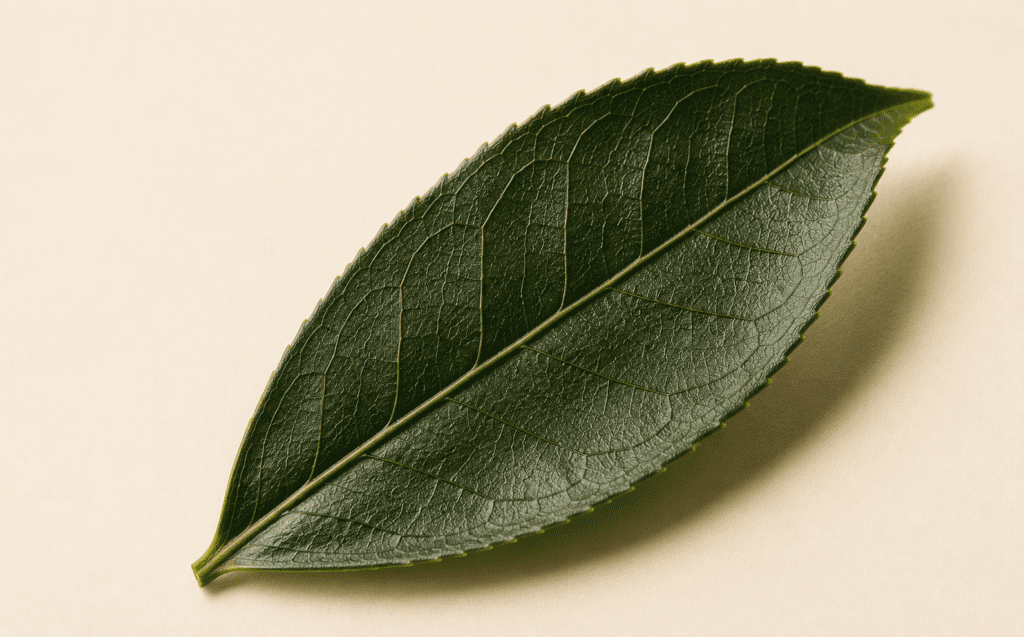
Matcha requires leaves that can be processed into a fine, uniform powder. The cultivar plays a direct role in this.
Leaves with thin lamina, less prominent veins, and limited stem development are better suited for tencha processing and fine grinding. They produce a powder that feels creamy and foams consistently. Cultivars with coarser veins or a thicker leaf structure tend to result in a gritty texture, an uneven mouthfeel, and a harsh, bitter aftertaste. This difference often only becomes apparent after grinding. In loose-leaf tea, it may remain hidden, but in matcha, it is inevitably revealed.
In traditional matcha-producing regions, you’ll find cultivars that have been used for tencha and matcha for decades, sometimes even longer. They’ve been selected for their flavor profile, not for maximum yield.
At the same time, modern cultivars have been developed that are more resistant to:
These modern cultivars are widely used in warmer regions and large-scale systems. They can produce excellent matcha, provided that the duration of shading, fertilization, and the timing of the harvest are carefully coordinated.
The distinction between classical and modern is therefore not a measure of quality, but a matter of choice.

A cultivar cannot be viewed in isolation from its environment. The same genetic makeup can result in completely different outcomes in different regions.
A cultivar known for its deep umami in a cooler region may grow more quickly in a warmer climate, retain fewer amino acids, and develop a fresher, more direct profile. Conversely, a modern cultivar in a classic region can become surprisingly refined. That is why a cultivar name alone means little. It only gains meaning when combined with terroir and management.
Modern breeding focuses not only on yield, but increasingly on quality under specific conditions. For matcha, this means developing cultivars that:
This development is important because climate change and increased production scale are placing new demands on cultivation. Without breeding, matcha production would become vulnerable.
At the same time, the challenge remains to ensure that taste is not sacrificed for the sake of efficiency.

In the market, the term “cultivar” is sometimes used to describe an exotic bonus, similar to grape varieties in wine. With matcha, however, that’s an oversimplification.
Cultivar explains:
Anyone who takes matcha seriously cannot ignore the cultivar.
This article is part of the Matcha dossier. The complete overview of all articles, from cultivation and processing to brewing and applications, can be found on the overview page: Matcha explained: from tea leaf to bowl.














Arabica, Robusta, Bourbon, Gesha, or SL28: the plant names on a coffee bag reveal something about the variety, flavor, and origin.

Is a lot of foam a sign of good matcha? Not necessarily.

This bright green tea powder comes from a remote mountain community in China and is perfect for tea and (iced) matcha lattes.


