

Laatst bijgewerkt op: 14/10/2026
Our daily cup of coffee has undergone a transformation over the past twenty years. Specialty coffee began as a niche subculture for enthusiasts who were simply looking for freshly roasted, truly delicious coffee. Now consumers can choose from a rich and diverse selection: a cortado at the café around the corner, a bottle of cold brew from the supermarket, or a carefully prepared cappuccino from a designer espresso machine at the office.
In Western society, coffee is still a daily ritual, but the specialty coffee movement has added a new dimension to that routine. Origin, flavor, preparation, and story have become part of what we drink. How did a niche of curious hobbyists grow so quickly into such a natural part of daily life? And does specialty coffee really remain special when you can order it on almost every street corner?
Let’s go back to the very beginning. Erna Knutsen, a coffee importer in San Francisco, California, coined the term “specialty coffee” in the 1970s and used it to describe coffee from unique microclimates, each with its own distinct character.
Alfred Peet, the Dutchman from Alkmaar who was making a splash around the same time at Peet’s Coffee in nearby Berkeley, California, became known as a headstrong, almost obsessive craftsman—someone who imposed his vision of flavor with an iron fist and turned dark-roasted coffee into a personal religion. For a new generation of coffee entrepreneurs, he became proof that coffee, too, could have character: bold, distinctive, and uncompromising. Peet’s eventually became a national coffee brand in the U.S.
In the Netherlands, my father, Jacob Boot, pioneered the same idea in Baarn. With The Golden Coffee Box, he turned coffee into an experience in the 1970s: freshly roasted, unblended Arabica beans, personalized advice for customers standing shoulder to shoulder in the small shop with its counter propped up on trestles and the twinkling miniature roasters. “Take a whiff of these beans—they suit your creative personality.” That’s where I learned the trade. When I let a roast go too far, my father stepped in. “Read the beans, son, read the beans,” he whispered, followed by a warm hug. A moment later, freshly ground beans filled the shop with notes of citrus, berries, and spices. Jacob looked around: “Cozy, isn’t it?” That was his coffee revolution: not a mass-produced commodity, but craftsmanship, personal attention, and an experience you could savor even before the first sip.
“Jacob Boot: Read the beans, boy, read the beans“
In the 1980s, specialty coffee also began to take on an institutional form. Ted Lingle and like-minded individuals founded the Specialty Coffee Association of America, giving quality, language, and standards a permanent home. What began as a select group of maverick pioneers who believed that coffee could be more than just an anonymous commodity grew into a movement with its own language, its own rituals, and ultimately its own industry. Specialty coffee became not only a category but also a culture: first centered on freshness and craftsmanship, later on flavor and origin, and ultimately, that focus came to influence the entire chain, from bush to cup.
Economically speaking, the specialty market is all about higher margins per kilogram and added value through retail, the foodservice industry, ready-to-drink coffee beverages—such as bottled cold brew—and other sales channels, including coffee subscriptions for home consumers and, not to mention, coffee for office consumption. The rapid growth of the specialty market speaks for itself. Originally a niche market for coffee enthusiasts, it has now grown into a global market worth over $100 billion: Grand View Research estimates the market at over $110 billion in 2025 and forecasts annual growth of over 10% for 2026–2033, which could bring the market to over $250 billion by 2033. This refers to a broad, commercial definition of specialty coffee, not exclusively coffee that is classified as specialty according to professional quality criteria.
An example of the economic impact of specialty coffee is Coffee for Peace (Colombia, 2018–2021), a project I led. It helped coffee farmers in former conflict zones make the transition to specialty coffee, with the goal of providing a profitable and legal alternative to coca cultivation. According to the final report, the project generated $6.8 million in direct export revenue, at prices that were, on average, 69% above the market price. The report estimates the additional income for the farmers at over $2.6 million.
The evolution of the coffee world is often described in terms of waves. The first wave turned coffee into an everyday product: inexpensive, packaged, and intended for every kitchen. The second wave gave coffee character and a sense of community, with espresso, lattes, and chains that turned coffee into an experience. The third wave (beginning around 2000) then introduced a new perspective: origin, craftsmanship, light roasting, and respect for the product.
“The second wave brought character and a sense of togetherness to coffee“
Blue Bottle became one of the symbols of that third wave. It started as a project by James Freeman, a former clarinetist who began roasting coffee himself in Oakland because he was fed up with over-roasted supermarket beans. Starting with a market stall and later a tiny kiosk, he built a brand centered on freshness, precision, and minimal frills: coffee shouldn’t be mass-produced, but it should be good.
Blue Bottle also felt completely different because of its understated, striking design. No dark branding, no flashy style—just an almost silent obsession with quality. Freeman focused on freshly roasted single-origin beans, meticulous preparation, and a minimalist style, as if coffee were a design object that only truly came to life when every detail was respected. That made Blue Bottle one of the defining brands of the third wave. When Nestlé acquired a majority stake in Blue Bottle in 2017, it became clear just how far that small world of specialty coffee had evolved. We are now in a phase beyond the third wave.
The recurring question regarding specialty coffee is not only how big the market is, but who actually benefits from it. In the coffee market, farmers are often left with only a small piece of the pie. Fairtrade International reported in 2023 that coffee producers typically receive only about 1 percent of the retail price of a cup of coffee. For a cup costing four dollars, that amounts to about four cents, although the proportions vary greatly by country, quality level, trade model, and sales channel.
This is exactly why the income situation of coffee farmers is so important. Specialty coffee can lead to higher prices, better quality, and stronger relationships, but without a fair distribution of profits, the luxury enjoyed by consumers does little to alleviate poverty at the source.
““Without fair distribution, consumer luxury does little to alleviate poverty at its source”
At the same time, climate stress makes things even more difficult. Research by Bunn, Läderach, Ovalle Rivera, and Kirschke (2015) shows that the globally climatically suitable area for coffee could decrease by about 50% by around 2050. This refers to modeled suitability, not a prediction that half of today’s coffee plantations will definitely disappear. The study compares climate projections for 2040–2069 with the historical climate baseline of 1950–2000; under the RCP 6.0 scenario examined, the losses for both Arabica and Robusta are significant. Meanwhile, coffee provides a livelihood for approximately 12.5 million farming families worldwide, many of whom struggle to earn a living wage, as described in the Coffee Barometer 2026.
Specialty coffee has matured as both a product and a market, but its credibility depends on what happens in the countries of origin. It’s not just the quality of the coffee that matters, but also stable prices, relationships with producers, and a more equitable distribution of value.
An interesting aspect of specialty coffee is that it has slowly returned to where it all began: at the source. That’s what makes Mokhtar Alkhanshali’s story so compelling. An American of Yemeni descent from San Francisco, he traveled to Yemen—the land of his family, which once became world-famous through the port of Mocha. There, he worked with farming communities in the highlands to revive the country’s coffee culture.
His journey was far from romantic. In the midst of the war, he collected coffee samples in more than thirty regions and eventually risked crossing the Red Sea in a small fishing boat, with two suitcases full of coffee, on his way to Djibouti. American author Dave Eggers later wrote *The Monk of Mokha* about this journey, an international bestseller that brought Alkhanshali’s adventure and the rediscovery of Yemen’s coffee history to global attention. In doing so, his personal journey also became a larger story: one of origin, identity, and the question of how specialty coffee can restore value to places that have long been overlooked.
Specialty coffee has not developed in the same way in every market. In the United States, the category is already deeply ingrained throughout the entire market, from supermarkets to specialty coffee shops; there, specialty coffee is no longer just a taste experience found in specialty shops, but a broad commercial market segment. Japan is known for its long-standing, unique coffee culture, in which the precision of preparation, the ritual of drinking, and the aesthetics of presentation come together. In *Coffee Life in Japan* (2012), anthropologist Merry White describes how this tradition, rooted in the coffeehouses of the late nineteenth century, has come to occupy a special place in Japanese urban and cultural life.
Scandinavia is strong in filter coffee culture and home consumption. Southern and Eastern Europe are evolving more slowly, but they are certainly not standing still. Espresso culture remains intertwined with local traditions surrounding coffee drinking, while specialty coffee is growing primarily in cities among younger consumers and through small, passionate roasters. In those markets, specialty coffee is still seen as something new, something you consciously choose; that makes the experience more intense and often even more delicious.
The growth of specialty coffee consumption in producing countries is one of the most interesting trends of the past decade. In Latin America, this is particularly evident in countries such as Brazil, Colombia, and Peru, where specialty coffee is no longer intended solely for export but is also becoming increasingly important for the local market. Brazil and Colombia are not only major producers but also countries with a growing urban coffee culture in which specialty coffee is becoming increasingly commonplace, particularly among younger urban consumers. This trend is also evident in the coffee shops themselves.
In Miraflores, Lima, Peru, there are many beautifully designed specialty coffee shops that source traceable microlots from Peruvian regions. The sleek design of these establishments is about more than just aesthetics; they are functionally designed so that coffee, atmosphere, and attention to detail take center stage. At the same time, they often reflect local identities and the region’s coffee culture, so the space not only looks modern but also feels rooted in the coffee’s origins.
“Specialty coffee is no longer intended solely for export but is also becoming increasingly important for the local market“
Something similar is happening in coffee-producing countries such as Thailand, Indonesia, and India. Thailand has a rapidly growing specialty market, with an estimated annual growth rate of 10 to 15 percent according to the Specialty Coffee Association of Thailand, while Indonesia and India are also undergoing tremendous changes, partly due to the gradually increasing prosperity of the middle class.

The rise of super-specialty coffees shows just how far the specialty coffee trend can go when quality, scarcity, and status converge. Coffee varieties such as Geisha, Pacamara, and Laurina are traded from countries like Panama, El Salvador, Costa Rica, and Ecuador at prices the average coffee farmer can only dream of. At the 2026 Best of Panama auction, the average price was around $4,055 per kilo, while the most expensive Geisha lot sold for $18,004 per kilo; a Laurina (a natural mutation of Bourbon) fetched $4,216 per kilogram.
It is precisely in parts of Asia that a subculture has grown up around this. In China, Japan, and South Korea, these coffees are not only a taste experience but also a status symbol: the packaging, the store, the digital platform, and the presentation of the beverage itself all come together to form a carefully crafted lifestyle narrative. China has accelerated this trend even further with an extremely efficient distribution system, in which coffee can be ordered and delivered at lightning speed via apps like WeChat. To the down-to-earth and sometimes frugal Dutch coffee drinkers, this sounds almost otherworldly. But in those Asian markets, specialty coffee has long since ceased to be merely a choice of quality; it is a form of self-expression.
The specialty revolution is far from romantic or a given for the coffee farmers whose work marks the beginning of the supply chain. Farmers must continue to navigate between bulk and microlots, between climate stress and market pressures, between quality and scale. Specialty coffee can mean a lot to producing countries, but only if it makes economic sense. Otherwise, it remains a story that sounds good in big cities but changes little on the farm and in the lives of the farming families themselves.
The more specialty coffee grows, the more the mainstream market takes over. This isn’t just happening in retail, but also in the language of the supply chains. English terms like “direct trade,” “origin story,” “traceability,” and “limited edition” have now become part of much larger coffee campaigns. As a result, specialty coffee is simultaneously spreading and being eroded: visible to more people, but also more vulnerable to superficial imitation.
“There, coffee becomes a quiet form of hospitality“
The office world follows the same pattern. Employers increasingly view coffee as part of the work experience. There, coffee becomes a quiet form of hospitality. That’s good news for roasters and for consumers, who are getting better coffee in more places. But it also raises a fundamental question: when specialty coffee appears everywhere, what makes it unique? The answer probably lies not in exclusivity, but in the degree of integrity with which the industry upholds its values.
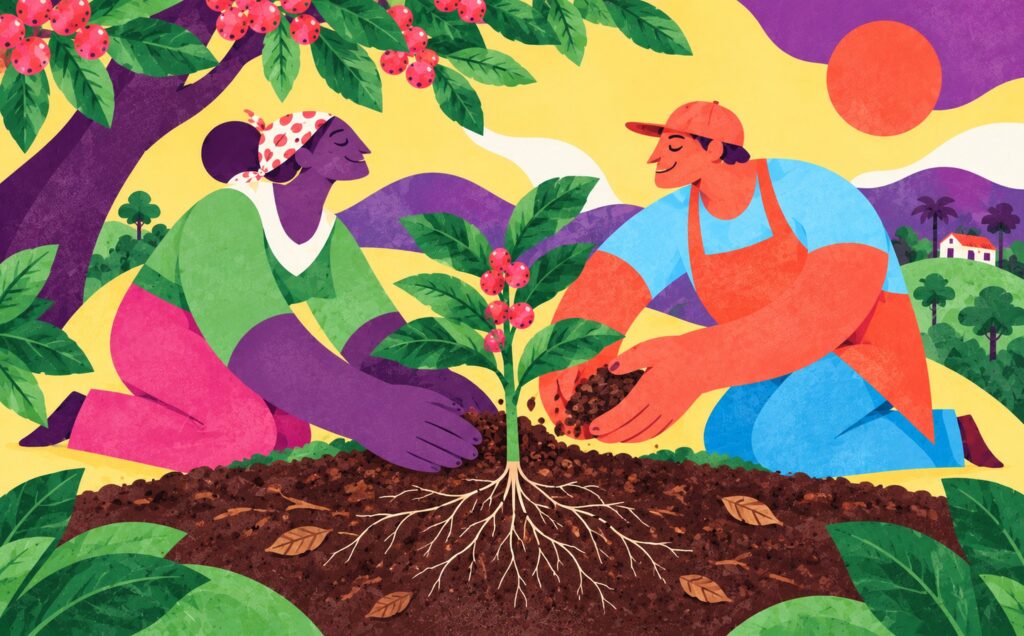
Sustainability is no longer just a slogan for specialty coffee. It touches on its very credibility. In its strongest form, it’s about long-term relationships, fair pricing models, climate adaptation, regenerative agriculture, and visible social impact in the countries of origin. In its weaker form, it’s mostly just a word on a package. The industry sits right in between those two versions. On the one hand, the market is growing rapidly, with reports pointing to robust global expansion through 2030 and beyond. On the other hand, the bar is being raised: consumers expect not only great flavor, but also accountability and transparency. As a result, “specialty” is becoming less of a distinguishing feature and more of a standard.
“Consumers expect not only flavor, but also accountability and transparency”
Still, there is room for real progress. The most interesting players aren’t necessarily the biggest, but those who combine innovation with responsibility: producers who develop their domestic markets, roasters who collaborate with farmers over the long term, and companies that use office or distribution channels not just to sell their story, but to share value. That’s where specialty coffee comes of age.
The coming years will not be defined by whether specialty coffee will grow. That question has already been answered. The real question is which form of specialty will ultimately become the standard. Will it be a light branding ideology, a cultural movement centered on flavor and origin, or an economic model in which producers, roasters, and consumers learn to understand one another better?
“True innovation usually starts on a small scale”
It will likely become a hybrid. The category has become too commercial to remain a niche, and too culturally charged to fully dissolve into the mainstream. For farmers, this means new opportunities as well as new pressures. For roasters, their role is shifting from buyer to storyteller, from seller to curator. For consumers, specialty coffee is becoming increasingly commonplace, but many exceptional coffees still originate in smaller, specialized businesses, where farmers and roasters experiment with new varieties, processes, and flavor profiles. That tension is exactly what makes specialty coffee so interesting: it’s becoming broader and more accessible, while true innovation usually begins on a small scale; as Jacob Boot, the Dutch specialty pioneer, put it back then: “Small Is Beautiful.”
Willem Boot was already working at the coffee roaster at the age of fourteen. The son of Dutch coffee pioneer Jacob Boot worked as a roaster, coffee taster, and roastery owner before founding Boot Coffee in 1998. From California, he advises coffee producers and roasteries on quality improvement. At the Boot Coffee Campus in San Rafael, near San Francisco, he and his team share their knowledge on topics such as roasting, cupping, and green coffee. He is also active at the beginning of the supply chain: he established Geisha coffee farms in Panama and Ethiopia. His search for the origins of this variety brings him back to Ethiopia.
Grand View Research — Specialty Coffee Market, 2026–2033.
Coffee for Peace — USAID, Colombia Producers to Markets Alliance, Boot Coffee Subcontract CRC#03, Final Report, December 2021.
Fairtrade International – Fairtrade Increases Coffee Minimum Price, March 30, 2023.
Bunn, Läderach, Ovalle Rivera, and Kirschke (2015) – A Bitter Cup: Climate Change Profile of Global Production of Arabica and Robusta Coffee.
Coffee Barometer 2026 – including pp. 8 and 13 (12.5 million farming households).
Merry White – Coffee Life in Japan (2012).
Specialty Coffee Association of Thailand.
Best of Panama 2026 – Timeless Resonance, auction results.
Erna Knutsen – Specialty Coffee Association, In Memoriam (2018).



















According to Spencer Hyman, founder of the artisanal chocolate platform Cocoa Runners, we need to learn to eat chocolate differently.

Yerevan is best known for its rich history, but is developing into a surprising destination for specialty coffee. On this city trip to the Armenian capital, you’ll discover hidden roasteries, modern coffee bars, and a traditional tea house.

From higher Fairtrade prices and coffee beans for home use to an exhibition on coffee and colonial history: here's what's happening in September.


