Home » Spencer Hyman: “We need to educate consumers to appreciate good chocolate”
Premium
Spencer Hyman: “We need to educate consumers to appreciate good chocolate”
Author: Demian van der Reijden
Laatst bijgewerkt op: 23/09/2026
The cocoa industry talks a lot about sustainability, certification, and better incomes for farmers. But according to Spencer Hyman, founder of the artisanal chocolate platform Cocoa Runners, real change starts somewhere else: with the consumer. Consumers need to learn to eat chocolate differently.
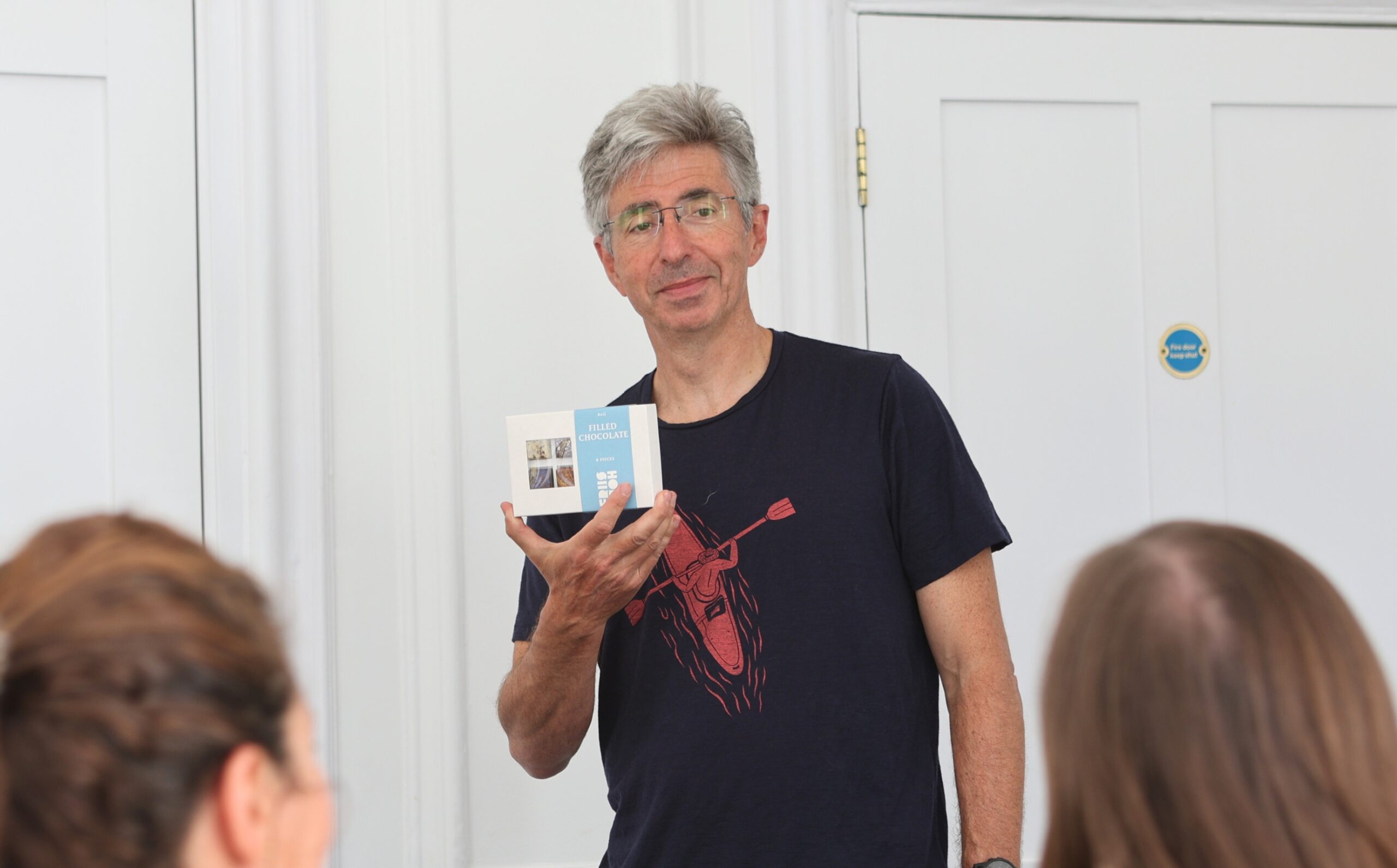
After a detour through the tech world, Spencer Hyman discovered craft chocolate about fifteen years ago. As a co-founder, he launched Cocoa Runners and set out to find the best chocolate bars in the world.
He likes to describe the company as a “chocolate DJ.” “Just as a DJ tries to find the best music for you, we search all over the world for the best chocolate.” Cocoa Runners sells that chocolate through subscription boxes, among other channels, but sees education as just as much a part of its mission. And according to Spencer, that’s precisely where one of the major challenges for craft chocolate lies.
Cocoa Runners at a Glance Cocoa Runners was founded in London in 2013 by Spencer Hyman and Simon Palethorpe and, according to the company, is the world’s first subscription service for craft chocolate. Subscribers receive four carefully selected bars from small-batch chocolate makers each month. Cocoa Runners has since grown into more than just a subscription service. The company operates an online store, organizes tastings and events, and supplies chocolate to coffee shops and wine stores, among others. According to Cocoa Runners, its selection includes more than 1,000 bars from over 120 makers.
Craft chocolate is still a tiny niche
When Cocoa Runners started, Spencer says there were only two serious craft chocolate makers in the United Kingdom. He now estimates that number to be between thirty and forty. In the United States, the sector has grown from a few dozen to several hundred makers.
That sounds impressive—until Spencer draws a comparison with specialty coffee. According to Spencer, an estimated 20 to 25 percent of coffee sales now fall under the specialty coffee category. Craft chocolate, on the other hand, accounts for only 0.1 to 0.2 percent of the chocolate market.
Spencer: “If there is a demand for chocolate that tastes good, then we need to enable farmers to produce high-quality cacao. That’s only possible if we pay them more.”
That difference partly explains why it’s so difficult to change the situation for cacao farmers. Specialty coffee is a relatively simple upgrade from an existing habit. You already drink coffee in the morning anyway, so you just choose a better one. With chocolate, it’s different.
According to Spencer, industrial chocolate is often eaten in the afternoon as a quick sugar rush. Good craft chocolate calls for a different way of enjoying it. “It’s savored, shared, and all about the flavor.” To be able to pay farmers better, chocolate must therefore evolve from a commodity that primarily delivers sugar into a product that consumers value for its flavor. “We really need to spark a revolution in the way people think about chocolate and flavor.”
Farmers Want Both Price and Security
According to Spencer, what cocoa farmers need is simple: “Higher prices and long-term contracts.” He says farmers no longer want to produce a commodity over whose price they have little influence and for which they have no certainty regarding future purchases.
This is particularly problematic in West Africa. According to Spencer, about 60 to 70 percent of cocoa comes from Ivory Coast and Ghana. A small number of large traders dominate that market. Farmers have virtually no way to opt out of that system.
Spencer: “Taste is like a language you have to learn. It’s like learning to play a musical instrument. It’s like learning to swim. You really have to show people how it works.”
According to Spencer, the spectacular rise in cocoa prices in recent years has not brought about sufficient change in this regard. “Some farmers have benefited from it, but most have not.” Spencer also questions the common explanation that the price increase was primarily caused by poor harvests and diseases. In his view, problems with the distribution of supply and speculators also played a role.
Behind that, he sees a more fundamental problem. The average age of cocoa farmers in West Africa is high, there is insufficient investment in new trees, and investment in infrastructure is also lagging. Climate change makes this even more urgent. “If you don’t build reservoirs and dams, those trees will die. It looks pretty bleak.”
In addition, the expansion of cocoa cultivation was long made possible by deforestation. On poor West African soil, new agricultural land could be created by cutting down and burning the rainforest. But, as Spencer dryly notes: “There isn’t much rainforest left to burn.”
Spencer: “Just as a DJ tries to find the best music for you, we search all over the world for the best chocolate.”
Spencer sees a notable trend in Asia. Thailand is on the rise, as are China, India, and Taiwan. These countries are developing both as producers and as markets for high-quality chocolate. According to Spencer, the rise of these countries is not so much a result of climate change as it is of growing prosperity. Consumers are seeking out new luxury products, including craft chocolate.
Teach cocoa farmers to taste chocolate
A second trend is production in the country of origin. Increasingly, cocoa is not being exported as beans but is being processed into chocolate locally. This allows more value to remain in the producing country.
But this immediately raises a new problem: knowledge of taste. “The average cocoa farmer has never tasted a chocolate bar,” says Spencer. As a result, farmers are asked to produce better cocoa without knowing how their work ultimately affects the taste of chocolate.
That’s why Cocoa Runners strives to train not only consumers but also manufacturers and farmers. “If you don’t start there, everything else is pointless.”
Taste is something you have to learn
This brings Spencer to perhaps his most important point. According to him, the biggest challenge for craft chocolate isn’t that there need to be more good bars. “There are plenty of fantastic bars.” The biggest challenge is, above all, that we need more consumers who understand why that chocolate is special.
We instinctively appreciate sweet, salty, and fatty flavors. Taste is something else entirely. “Taste is like a language you have to learn. It’s like learning to play a musical instrument. It’s like learning to swim. You really have to show people how it works.”
That’s why he sees a lot of potential in tastings and other chocolate experiences, similar to what wineries do. When someone sees two bars in a store—one industrial and one artisanal—they don’t automatically understand why one is so much more expensive. According to Spencer, it’s only when people learn to taste and acquire the vocabulary to describe the differences that they become willing to pay for flavor. And that ultimately creates room to pay farmers more.
Certification misses the Mark
Spencer is not very enthusiastic about certifications like Rainforest Alliance and Fairtrade. “Great for the people who carry out the certification. It doesn’t help consumers, and it doesn’t help farmers much.”
He says the ideas behind them are good, but believes they do not solve the fundamental problem. He also views the sustainability programs of major chocolate companies primarily as risk and reputation management. In a market where cocoa is primarily a commodity, he believes that price will ultimately remain the deciding factor.
According to Spencer, artisanal chocolate makers start from a different place. If you want to make chocolate with a distinctive flavor, you have to know where the cacao comes from and how it was processed. “You have to work with the farmers. That’s why transparency is incredibly important.”
“Tony’s mainly makes consumers feel good”
Spencer is also strikingly critical of Tony’s Chocolonely. He acknowledges that the Dutch brand has done “great work” by making consumers aware that the chocolate supply chain has major problems. But he then emphatically distances himself from the chosen solution.
Spencer: “Tony’s Chocolonely is as transparent as mud”
His objection is that, in his view, Tony’s still operates within the same consumption model as traditional chocolate brands. According to him, the main goal remains for consumers to replace a regular chocolate bar with a Tony’s bar. “Tony’s also wants you to eat a lot of bars. In 14 of the 20 bars they sell in the UK, sugar is the main ingredient. They’re not trying to get people to appreciate the flavor. And that’s the only way people will pay more.”
“As transparent as mud”
He also finds the brand’s transparency lacking. Among other things, he points to sugar, the main ingredient in many bars. According to Spencer, Tony’s does not communicate clearly enough where that sugar comes from. He makes the same criticism regarding the exact origin of the cocoa. His verdict is harsh: “They make consumers feel good and ensure that consumers stop asking further questions.” Regarding the claim of transparency, he then says: “They’re as transparent as mud. You really have to dig deep into the fine print to find anything about the cocoa farmers and cooperatives they work with.”
This criticism calls for some nuance. Tony’s is actually quite transparent about the cocoa it uses: the company says it can fully trace its cocoa through the Tony’s Open Chain program back to specific cooperatives in Ghana and Ivory Coast, and publishes extensive information about this. When it comes to sugar—the main ingredient in many bars—that transparency is much more limited. Tony’s states that it uses Fairtrade sugar but applies the mass balance principle. As a result, the exact origin of the sugar in a specific bar cannot be traced in the same way as the cocoa. Spencer’s claim that Tony’s primarily wants consumers to eat more chocolate also contradicts statements made by Tony’s CEO Douglas Lamont. In an interview with the Financial Times in 2024, Lamont said he actually supports a message of moderation. His reasoning: if consumers eat less chocolate, they can afford to pay more for the cocoa.
Ultimately, it’s all about taste
Spencer’s vision ultimately always comes back to the same point. According to him, higher prices for farmers, better cocoa, and a future-proof sector don’t start with a certification label or a new marketing claim, but with a demand for quality.
To achieve this, chocolate must break away from the role it has assumed over the past century as a sweet snack. Consumers must learn to view chocolate the same way they view wine, tea, and specialty coffee: as a product in which raw materials, processing, craftsmanship, and flavor make all the difference. “If there is demand for chocolate that tastes good, then we need to enable farmers to produce high-quality cacao. That’s only possible if we pay them more.”
And that’s exactly where Spencer sees Cocoa Runners’ role. In addition to selling high-quality chocolate, they also help consumers understand why it’s high-quality. Because without consumers who can taste the difference—and are willing to pay for it—there’s ultimately no revenue model for the farmer who makes that difference.
Would you like a subscription to bean-to-bar chocolate, specialty coffee, and fine tea? With the KTC Specialty Box, you’ll receive a selection of the best bars, beans, and leaves four times a year! Click here
Want to learn more? Join koffieTcacao and get access to exclusive articles, interviews, and tips on specialty coffee, tea, and cacao. That way, you’ll always stay up to date on trends, gear, and events.