


Laatst bijgewerkt op: 17/06/2026
What began as a quest to generate additional income for cocoa farmers could turn into something much bigger for Lars Gierveld. He started by pressing and marketing cocoa fruit juice under the brand name Kumasi. And along the way, a question arose: what does that pressing actually do to the cacao bean? The answer turned out to be surprising: chocolate made from pressed cacao beans scores higher than chocolate made from the same, but unpressed, beans. This is the story of the birth of “superior beans,” which could very well be good news for cocoa farmers.
Seven years ago, Lars Gierveld began experimenting with pressing cocoa fruits together with cocoa farmers in West Africa. The idea was simple: to offer farmers an additional source of income by using the fruit juice from the pulp surrounding the beans instead of throwing it away. Kumasi now has its own production facility in Ivory Coast, in partnership with ETG/Beyond Beans and the Chocolonely Foundation (Tony’s Chocolonely). The soft drink cans made with cocoa fruit juice are now not only on the soft drink shelves at Hema and Albert Heijn, but also in Dutch restaurants and cafés and, in collaboration with a local soft drink partner, even in major supermarkets in Ivory Coast itself.
Gradually, another question arose: what actually happens to the cocoa beans during pressing? And how does the chocolate made from them taste? Those questions led to what Lars himself calls a “wonderful serendipity.” It turned out that not only did the beans remain intact during pressing, but the chocolate made from them also tasted better than chocolate made from exactly the same beans that hadn’t been pressed.

Lars doesn’t come from the food industry, but from journalism. When he left for Ghana and Ivory Coast, he had no intention of becoming an entrepreneur. He wanted to make a documentary about the abuses in the cocoa industry. While filming and talking with farmers, he saw an industry full of sustainability claims, but also a persistent problem. “Everyone has sustainability reports,” he says. “Everyone commits—or at least claims to commit—to meeting an ever-increasing number of standards and impact goals.” But beneath all those ambitions, he believed, lay one more fundamental problem. “The farmers’ income simply wasn’t high enough.”
According to Lars, that low income has direct consequences. “If your income isn’t high enough, child labor and illegal logging are just around the corner,” he says. In practice, paying more for the beans proved difficult. According to him, major chocolate companies were unwilling to do so, for fear of ‘disrupting the global market.’
Lars: “We’re in talks with a number of medium-sized companies that want to have more control over quality.”
At the same time, he noticed that there was something else surrounding the bean that was being completely overlooked: the pulp and the juice. “Nothing was being done with it; it just seeped into the ground.” That insight marked the beginning of Kumasi. If the price of the bean couldn’t simply be raised, then perhaps extra value could be extracted from the rest of the fruit. Together with farmers, Lars began experimenting with pressing and processing cocoa fruit juice.
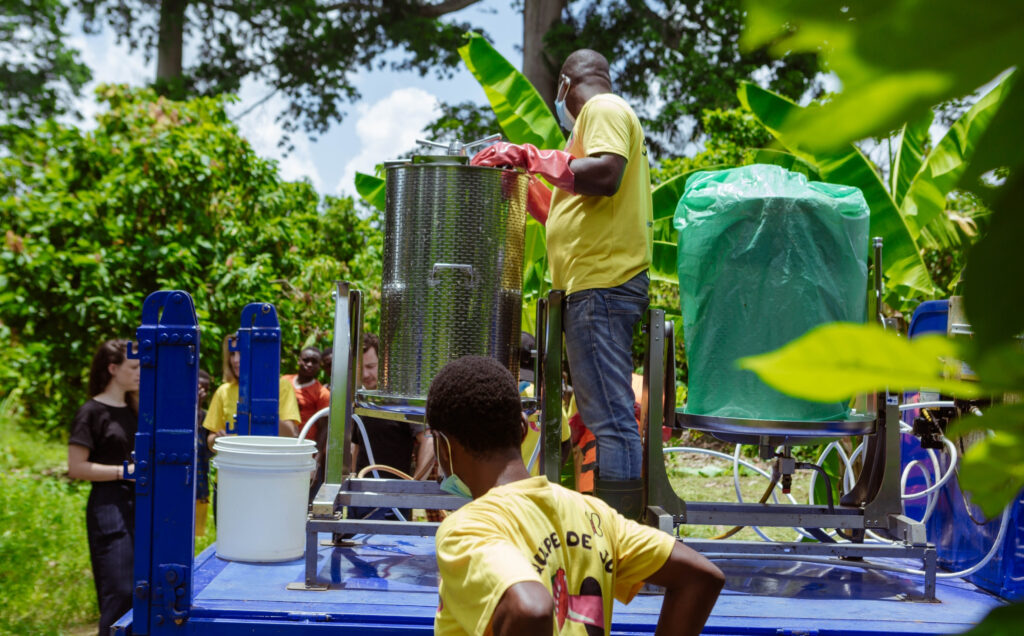
To make cacao fruit juice, the “wet” beans (cacao beans still surrounded by their pulp) must be pressed in a hydraulic press. A logical question soon arose, says Lars: “What happens to those beans during pressing? Don’t they break? And what does partially pressing out the juice mean for fermentation? Because in the traditional processing method, both the juice and the pulp are needed in that process.”
Lars: “In tests, the pressed bean consistently came out on top.”
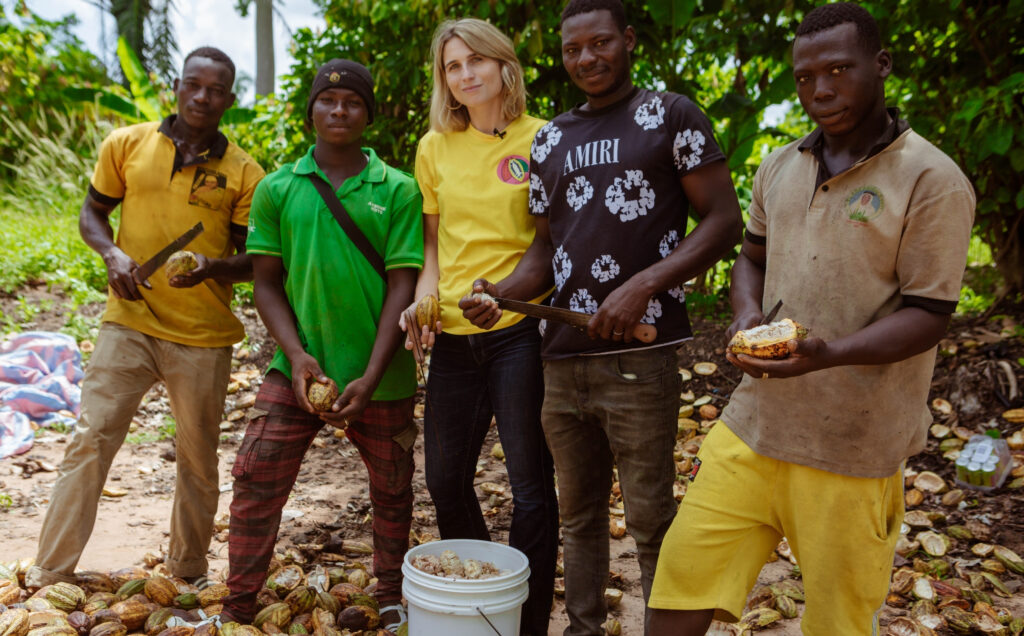
Kumasi launched a two-year research project in collaboration with Hanze University of Applied Sciences, cacao expert Henk-Jan Laats of the Cacao Museum, and researcher and cacao entrepreneur Anna Laven. Kumasi co-founder Linda Klunder (center in the photo below) oversaw the practical aspects of the project from Ivory Coast, where she lived for those two years.
It soon became clear that the beans held up well during pressing. Then came the more interesting part: fermentation. According to Lars, Kumasi presses out about 70 to 80% of the juice. You’d expect that to disrupt the fermentation process, but he says the opposite actually happened. “It seems to have a positive effect on fermentation,” he says. “The temperature of the beans is much more consistent.”
The study conducted with the universities of applied sciences—which also involved Dutch fermentation experts—showed that pressed batches do indeed exhibit more consistent behavior during fermentation. Whereas unpressed batches more often exhibit temperature differences between the top and bottom, Lars explains that pressing out excess juice results in a much more stable process. The pH level also remained more balanced, which is important for fermentation and sugar conversion.
In the end, the decision had to come down to taste. Kumasi had blind taste tests conducted by cacao experts. “The pressed bean consistently came out on top,” says Lars. The company then had chocolate made from both pressed and unpressed beans of the same cocoa variety. “Because it’s nice when a few cocoa experts can taste a difference in the bean,” says Lars, “but we also wanted to know: what can you still taste when you turn it into chocolate?”
To prevent the sugar from masking the differences, Kumasi chose chocolate with a high cocoa content of 72%. There, too, the chocolate made from pressed superior beans scored better than that made from unpressed beans.
That’s exactly what Lars means by “serendipity.” Kumasi didn’t start out with the goal of making better chocolate, but rather to extract more value from the cacao fruit. It wasn’t until later that they realized that same process might also improve the quality of the bean.
According to Lars, this discovery highlights a larger problem in the cocoa sector. In the coffee industry, quality differentiation is already much more commonplace, but in the cocoa sector —especially in West Africa—the focus is still often on bulk production. As a result, differences in production methods and quality are lost in a single, anonymous mass flow. At the high end of the market, there is indeed a world of bean-to-bar and “cacao of excellence,” but that is a niche market with high standards and high prices.
Lars sees an opportunity for something new between the mass market and the premium segment. Not the niche market of an 80-gram bar for ten euros, but a product that is demonstrably better and offers greater control over quality than the standard mass-market offerings. Kumasi uses the term “superior beans” to describe this new quality category.

The question arises as to whether this method of simple quality improvement will also be embraced by major cocoa processors such as Mars or Nestlé. But Lars does not expect those major chocolate players to simply start working with superior beans. There are several reasons for this. First of all, their supply chains are geared toward large volumes and existing processing methods. Pressing for fermentation requires different facilities, different logistics, and a different way of working.
Lars: “We’d like to play a role in connecting high-quality beans from West Africa with chocolate makers and traders.”
In addition, the stream of pressed beans must remain strictly separate from unpressed beans. Only then can their origin and quality be traced. This makes the system more complicated in an industry that is built precisely on scale and uniformity.
There’s another factor to consider: major brands don’t just sell chocolate—they also sell predictability. “If a KitKat tastes different tomorrow because they used higher-quality cocoa, customer service will be swamped with complaints,” says Lars. “Consumers want a recognizable taste in a product like that.”
Still, he does notice interest in the market. Not necessarily from the very biggest brands, but rather from smaller players who set themselves apart through quality. “We’re talking to a number of medium-sized companies—who want more control over quality—about superior beans.” And the Kumasi factory in Ivory Coast is now supported by funding from companies including Tony’s Chocolonely, Hershey, and Ferrero. According to Lars, they, too, recognize that adding value to byproducts can generate extra income for farmers without disrupting the global market price of cocoa.
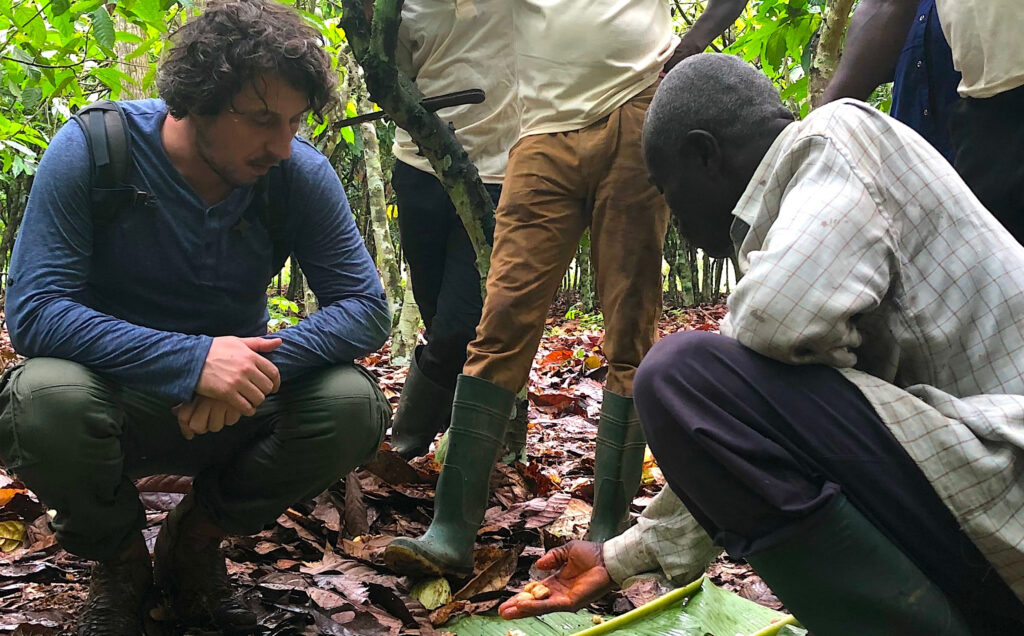
Lars explicitly links the discussion of quality to the income of cocoa farmers. For him, this isn’t just a technical or culinary issue, but also an economic one. “If that bean is demonstrably of higher quality, then the farmer should also get paid more for it,” he says. “And a farmer is, after all, a businessman. If you don’t pay enough, they simply won’t do it. Only when we show that this method produces less waste and more money without requiring much extra work will we have something that’s not only interesting to the farmers but could transform the entire industry.”
And that aligns with Kumasi’s broader ambition: not just to be a beverage brand, but to extract more value from the entire cacao fruit so that farmers can ultimately benefit from it. And in the best-case scenario, that farmer even has some money left over to invest in their business, which further improves quality. To encourage this, Kumasi pays the farmers for their cocoa pulp—unlike many other cocoa companies—at the time of processing. Since this takes place on the same day as harvesting—which is almost always done by hired workers—farmers can pay those pickers immediately that same day and don’t have to borrow money to do so, thereby avoiding the associated debt problems.
In addition to juice and the cocoa bean, Kumasi also sees opportunities to use the husks, for example. To that end, the company is now doing business with Forbo, a major flooring manufacturer that incorporates tons of cocoa bean husks into its flooring each year—husks that would otherwise have been turned into animal feed. The logic is always the same: something that was of little value gains more value, and cocoa farmers earn extra income from that added value.
Furthermore, not all of the cocoa fruit juice pressed at the Ivorian factory ends up in Kumasi’s soft drinks anymore. It is now also sold to chocolate makers, ice cream and candy manufacturers, among others, who use it as a filling and natural ingredient.
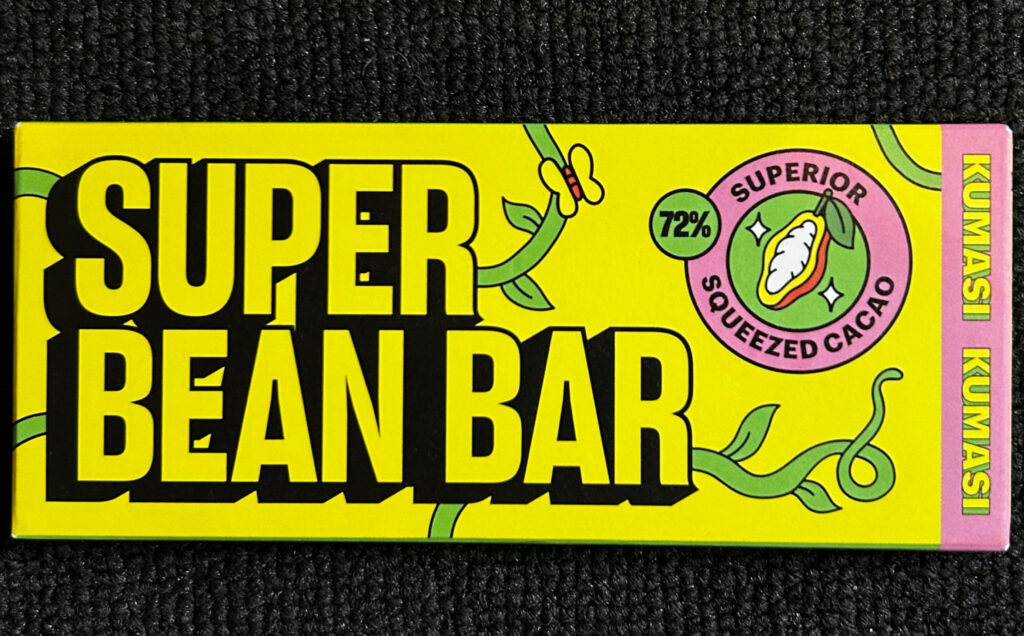
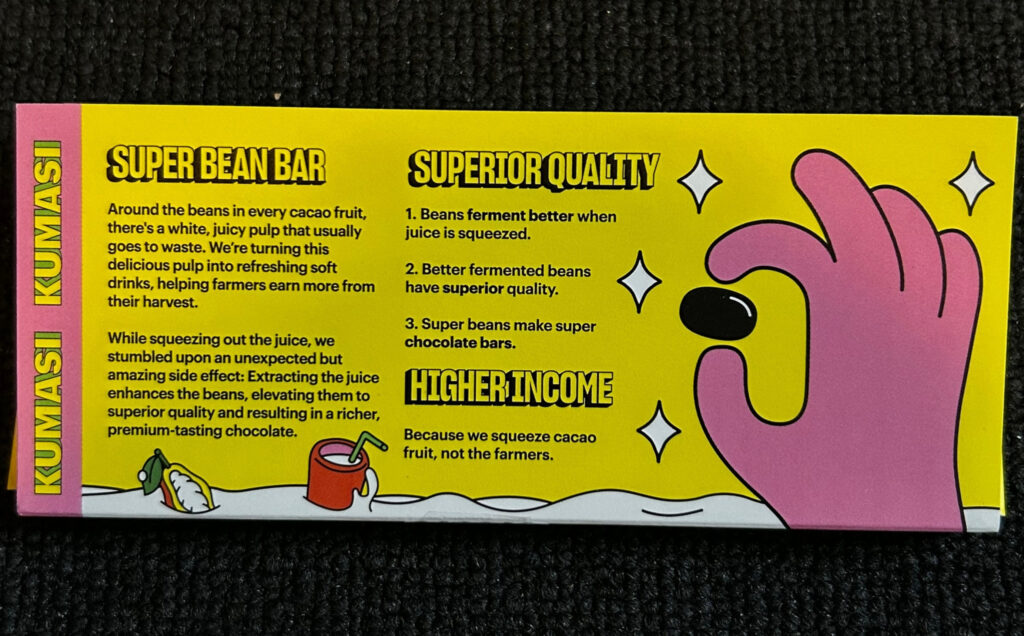
Lars doesn’t necessarily want to start his own chocolate brand in Kumasi. The bars made from superior beans are produced in small batches under the name Super Bean Bar and are not for sale—he uses them for testing and to convince representatives from chocolate brands.
So, no in-house chocolate line. His ambition is to help build a market for superior beans and, in doing so, ensure that farmers earn more from both their cocoa liquor and their higher-quality beans. “We’d like to play a role in connecting superior beans from West Africa with chocolate makers or traders,” he says. “The initial discussions are promising. We’re open to talks with other parties interested in higher-quality cacao and making a positive impact on cacao farmers.”
Superior Beans: Put Them to the Test
The editors at koffieTcacao received two bars from Lars: a Super Bean bar made from “superior beans” (pressed cacao beans) and a bar made from the exact same cacao, but unpressed. Both consist of 72% cacao mass.
Unpressed beans
Classic dark chocolate profile: bold and distinctly bitter. The mouthfeel is firm and slightly grainier. The color is a classic brown, with some crumbly edges.
Pressed beans
Striking notes of red fruit, a beautiful balance of bitters with liveliness and fresh elegance on the palate. The mouthfeel is not grainy but smooth. The color is warm brown with a hint of burgundy, and the bar has a sleek finish with smooth edges.













Arabica, Robusta, Bourbon, Gesha, or SL28: the plant names on a coffee bag reveal something about the variety, flavor, and origin.

Is a lot of foam a sign of good matcha? Not necessarily.

This bright green tea powder comes from a remote mountain community in China and is perfect for tea and (iced) matcha lattes.


