


Laatst bijgewerkt op: 13/10/2026
There are dozens, if not hundreds, of myths, fables and misunderstandings about coffee. Myths about the discovery, myths about the properties and misunderstandings about the health effects of coffee. We list ten common myths. Which is true and which is not?
This article comes from the rich archives of 12 years of KTC magazine. Every now and then we dive into that archive to bring out the best gems and present them to all members!
Do your own treasure hunt? Check out here the complete (searchable) archive with all 55 editions! (exclusive for members)
That we call coffee beans “beans” is actually strange. A bean is a legume and coffee is, well, not. Technically, coffee is a drupe: the semicircular coffee beans as we know them are the seed halves of the coffee berry. They are (usually) in pairs, flat sides together, inside the berry. However, roasted coffee beans do look a bit like dried brown beans.
And that’s one of the reasons we call them that. When coffee came to Europe in the 17th century, we already knew brown beans here – also an exotic product. And because they looked similar, we called coffee beans “beans. There is a second reason for calling coffee beans beans. In Ethiopia, which is generally considered the cradle of arabica, they call coffee “buna,” and of course that word is very similar to our word “bean.
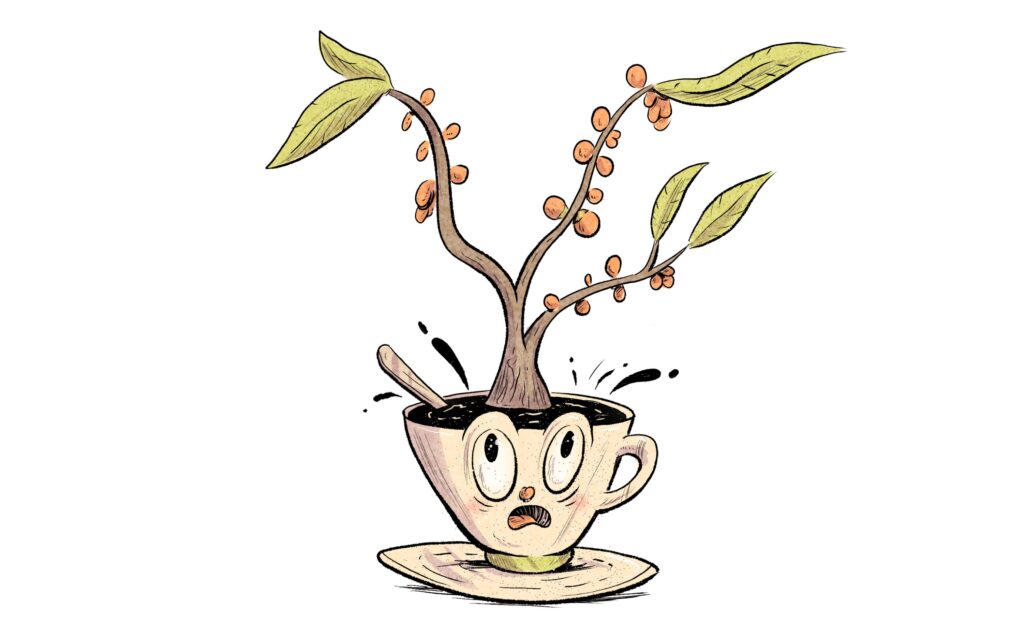
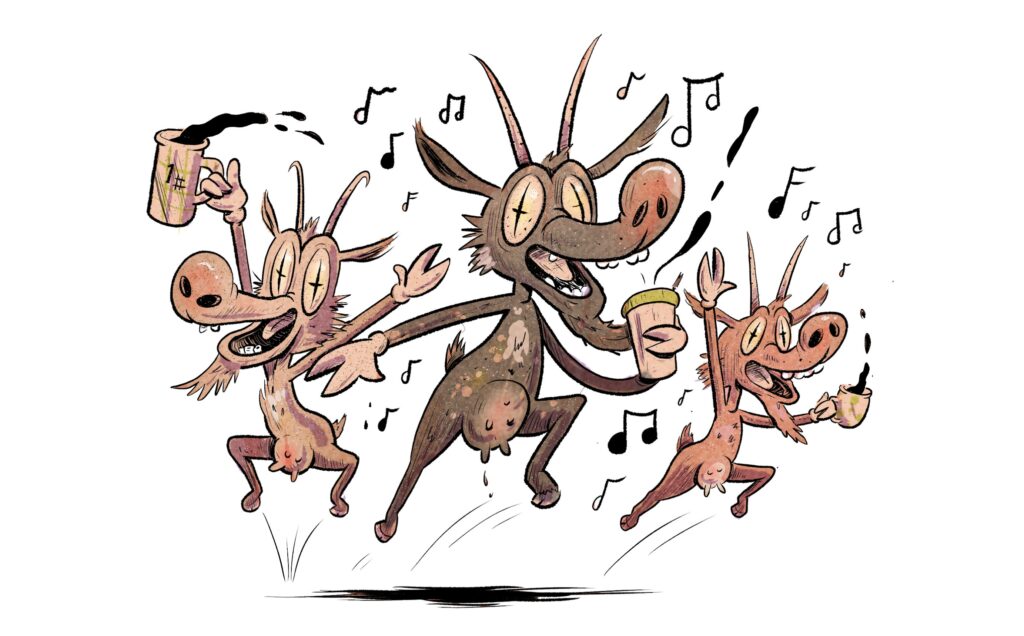
One of the most told – and most imaginative – myths about coffee, is the one about its discovery. You may have heard the name “Kaldi” before in this context. The myth goes that around the year 850, Ethiopian goatherd Kaldi, a boy still, discovered that after eating certain berries, his goats had so much energy that it made them dance. Kaldi tasted the berries himself, got excited and took them to the imam (Ethiopia was part of the Arab Empire at the time). However, he saw the dancing goats as the devil’s work and threw the berries into the fire. The resulting smell was so pleasant that Kaldi removed the scorched berries from the fire, crushed the seeds and sprinkled the grind into hot water: the first cup of coffee ever.
A second version of the story is about an Arab cleric, who ate of the berries while traveling through Ethiopia. He found the kernels too bitter and roasted them. This made them too hard, after which he boiled them. This produced a brown, fragrant liquid: coffee. The first written reference to coffee is found in Sufi texts from the late 15th century. For a long time, coffee was emphatically associated with the Islamic faith: it was drunk exclusively by clerics to stay awake during night prayers.
Whew, a little coffee purist will agree with this myth about coffee. But in fact, there is little difference: decaffeinated coffee (aka: “decaf”) is also made from ground coffee beans, and decaffeinated is not another coffee variety either. Only after processing (and before roasting) the caffeine has been removed from the green coffee beans.
To do that, there are several ways. It can be done usingCO2, which is pumped at high pressure at the green beans. TheCO2 then acts as a solvent that only dissolves the caffeine and removes it from the bean. With another method, the beans are steamed to open the pores, then rinsed with a solvent and then steamed again to remove residues of that solvent. There are also several methods that first soak the beans in hot water, which releases caffeine and other flavorings from the bean. Then, with or without chemicals, the caffeine is removed, after which the flavorless beans are soaked in water again so they can reabsorb the other flavorings.
Each method, apart from the caffeine, also impacts the final taste of the coffee. But, basically, therefore, you can make a decaffeinated version of any coffee you want. Myth debunked.
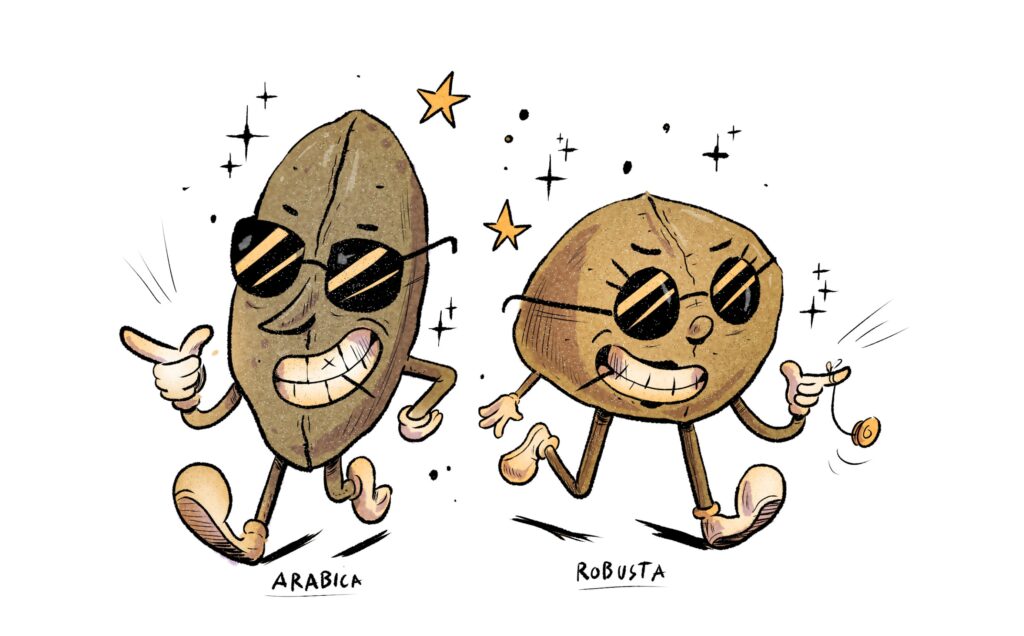
This was true for a very long time, but that had more to do with cultivation and processing than with the intrinsic quality of the coffee variety. Robusta was later discovered and treated as an “additive to arabica coffee. Once it was clear that arabica could achieve delicate flavors, farmers and producers began to develop on it.
Still generally considered inferior to arabica, robusta is mainly used for instant coffee, bulk coffee and as a filler in blends, to add body and a nice crema. But meanwhile, the differences between arabica and rubusta are diminishing. There are already coffee farmers who treat robusta in the same way as arabica and produce high-quality coffee with it, which is not inferior to good arabica and can also score 90+ in cuppings. This is still only happening on a relatively small scale. However, this may be one of the saving graces for coffee: now that arabica can no longer grow in some places due to climate change, quality robusta can help meet the demand for coffee.
No, (too much) coffee does not dehydrate you. Caffeine does have a mildly increasing effect on the production of urine (diuretic effect), so it is in fact slightly diuretic. But the water in coffee more than compensates for that, so you can just count coffee toward your daily fluid intake.
People who drink coffee regularly develop a tolerance to the diuretic effect of caffeine. This means that the dehydrating effect, which is already very slight, diminishes over time and even disappears in regular coffee drinkers. What fuels this fable is that coffee does allow you to feel dry in your mouth: acids in coffee can irritate mucous membranes, contributing to dry mouth. Hot coffee can also temporarily reduce saliva production, thus drying out the mucous membrane. And coffee contains astringent (drying) substances such as tannins. These substances can also reduce saliva production, which can lead to a dry feeling in the mouth.

Of all the myths about coffee mentioned here, this is the only one that is both true and false. Good crema means a well brewed espresso, but it does not directly say anything about the taste or quality of the coffee. The crema mainly contributes to the mouth feel and not so much to the taste. By the way, we first need to establish what a “good” crema is. According to the SCA, it is 1 to 5 millimeters thick, and elastic: the crema closes by itself after you stir (gently). The color is hazel brown – possibly with ‘tiger skin’ – and shiny, without (large) bubbles.
You can get relatively nice crema on an espresso from moderate robusta that has just been roasted. Robusta provides a firm crema and freshly roasted coffee is still degassing, so the crema is ‘blown up’. Visually, the crema will make this quite an attractive espresso, but will it taste good?
A designation as “the best” is, of course, debatable. And, if you take it very literally, no coffee comes from Italy – at least, it is not grown there. Italy is the cradle of espresso and has a deep-rooted coffee culture. But that says little about the quality of that coffee. That the best coffee comes from Italy is a myth.
Coffee is still roasted relatively dark in Italy, which makes it bitter. And so Italians often drink their espresso with sugar to soften that bitter taste. There is most certainly good coffee coming from Italy, there are very good roasters there as well. But it is not said that the best coffee comes from Italy. And it is certainly not true that all coffee from Italy is good.
Who doesn’t know it: the urge for a toilet visit about fifteen minutes after that first cup of coffee in the morning… This doesn’t actually fall under the heading of “myths,” it’s more of a “fact about coffee. There are several reasons for this laxative effect. First of all, caffeine has a stimulating effect on the contraction of muscles in the gastrointestinal tract. In addition, coffee also contains other chemical compounds, which can stimulate the production of stomach acid. And coffee stimulates the release of certain hormones and neurotransmitters, which play a role in the digestion of fats and proteins, and influence intestinal activity.
All causes food to be moved through the digestive system at an accelerated rate. Also, all hot drinks in themselves have a laxative effect: heat can dilate blood vessels in the digestive system and stimulate peristalsis.
For all these effects, by no means everyone experiences them in the same way and to the same extent. So the effect of coffee on bowel movements is different for each person, some do not even experience it at all.
This is not even one of the myths, but one of the most persistent fábels about coffee. You regularly read, even in serious publications about coffee, that it is “the most traded commodity after oil. In export value, that may have been true in the 1970s, especially in the years of the oil crisis. But since then, coffee has been overtaken in that area by other agricultural products such as grain and cotton, and especially by valuable metals.
The total export value of coffee in 2024 was around 42.5 billion euros (0.22% of total world trade), representing spot 86. In comparison, the export value of oil was 1.1 trillion euros(spot 1 – 5.7% of world trade). Coffee is also far behind oil in volume. In 2024, some 5 billion tons of oil were traded worldwide (spot 1) and over 9 million tons of coffee (spot 55).
Espresso tastes stronger and looks thicker, so it must also contain more caffeine, right? That depends on how you look at it. If you order an espresso and a black coffee in a café, those cups contain about the same amount of caffeine – after all, both are prepared with about the same amount of ground coffee. Only, the volume of espresso is much lower. So a milliliter of espresso does contain more caffeine than a milliliter of “regular” black coffee. This is true only if the regular black coffee is prepared with an espresso machine: i.e., a lungo or an americano. In the case of filter coffee, that cup contains even more caffeine than an espresso.
A 30-milliliter shot of espresso, made with 7-8 grams of coffee, contains about 65-75 milligrams of caffeine (and so does an americano). In a lungo a little more, as the water has been in contact with the ground coffee a little longer, allowing more caffeine to dissolve. But these are not tens of milligrams more. In filter coffee, depending on the brewing method, the water comes into contact with the ground coffee much longer. A 240-ml cup of filter coffee can contain as much as twice as much caffeine as espresso: 95 to as much as 165 milligrams. So for this fable, if you compare a cup of espresso to a cup of filter coffee or lungo, espresso loses out on amount of caffeine. At equal volumes, espresso wins hands down.



















According to Spencer Hyman, founder of the artisanal chocolate platform Cocoa Runners, we need to learn to eat chocolate differently.

Yerevan is best known for its rich history, but is developing into a surprising destination for specialty coffee. On this city trip to the Armenian capital, you’ll discover hidden roasteries, modern coffee bars, and a traditional tea house.

From higher Fairtrade prices and coffee beans for home use to an exhibition on coffee and colonial history: here's what's happening in September.


