Laatst bijgewerkt op: 13/10/2026
Arabica and Robusta are the world’s best-known coffee beans used for brewing coffee. Yet there’s a world of difference between them in terms of flavor and caffeine content. Here are the five differences.
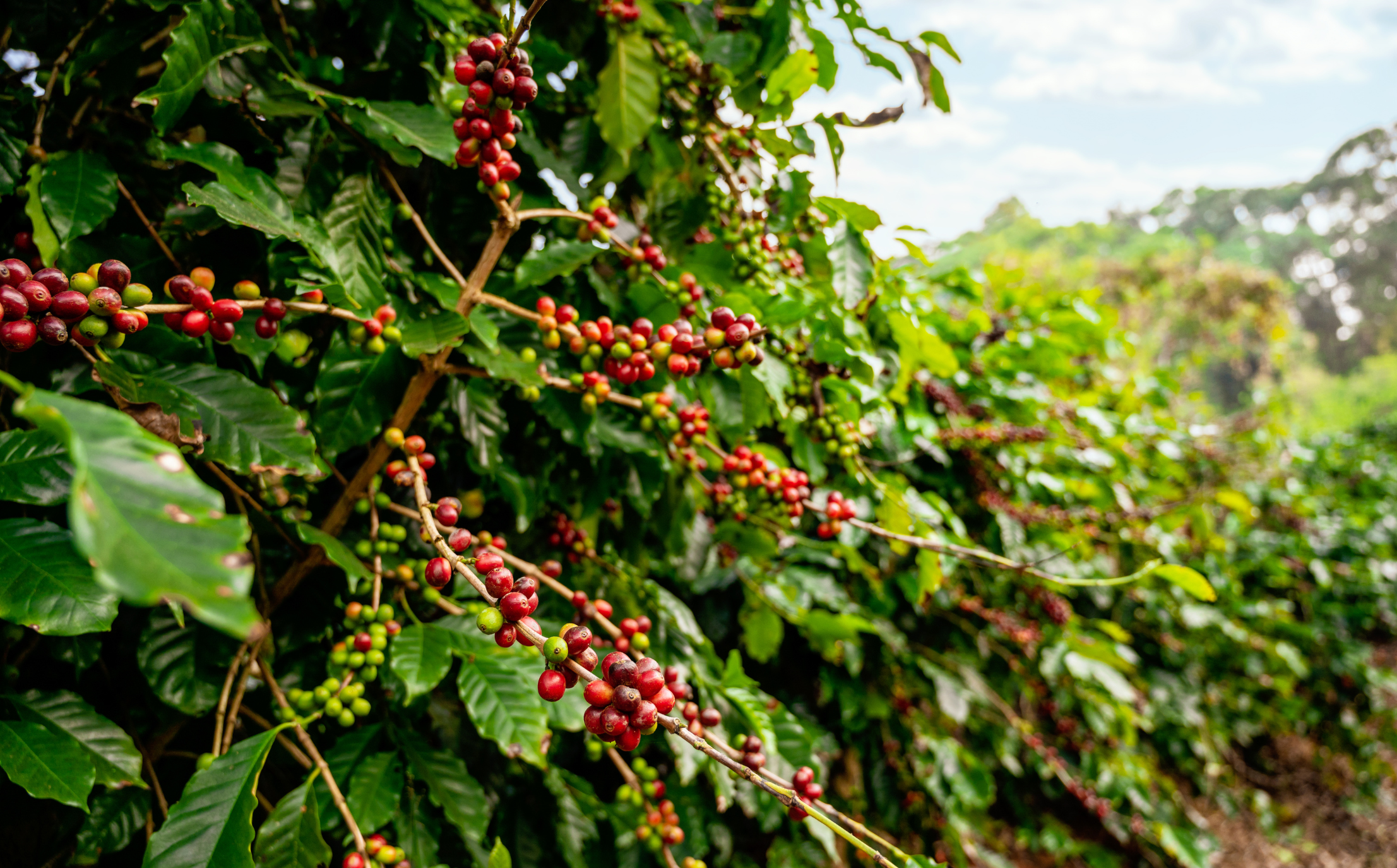
Arabica and Robusta coffee plants bloom once a year. After this blooming period, berries grow on the plants, each containing two seeds—the coffee beans. The berries are picked as soon as they are ripe. The differences between these coffee varieties lie in the region where the plants grow and in the beans themselves. For example, the Arabica bean is oval with a curved line down the middle, while the Robusta bean is round with a straight line.
1. Flavor Profile
Arabica beans are known for their refined flavor, complexity, acidity, and fruity aromas. They generally have a sweeter taste with hints of chocolate, nuts, or berries. As a result, Arabica coffee is more approachable in flavor than Robusta coffee, which has a stronger, more bitter taste with woody and earthy notes.
2. Origin of Arabica and Robusta Beans
Coffee beans grow best in the coffee belt: these regions are located between the tropics of the sun and the equator. But while Arabica beans thrive in higher-altitude regions with moderate temperatures (such as in Africa and Central and South America), Robusta beans grow well at lower altitudes (up to 1,000 meters) and in warmer climates, such as in Southeast Asia. Because robusta is highly resistant to drought and heat, this variety requires less care than the arabica bean.
3. Caffeine Content
If you’re looking for a strong energy boost, Robusta coffee is the right choice. These beans contain nearly twice as much caffeine as Arabica beans. Why is that? To protect itself from diseases, a coffee plant produces caffeine. This acts as a natural defense mechanism. At higher altitudes, there are fewer diseases and parasites, so the Arabica plant needs to produce less caffeine than the Robusta plant.
4. Price of Arabica and Robusta
Because Arabica beans require more complex growing conditions, they are generally more expensive than Robusta beans. In addition, the yield of high-quality beans from the Arabica plant is lower than that of the Robusta plant. This is another reason why you pay a bit more for Arabica coffee.
5. Usage
70 percent of the coffee consumed comes from the Arabica bean and 30 percent from the Robusta bean. The Arabica variety is therefore much more popular because of its complex and rich flavor. Coffee beans from the Robusta plant are often used in coffee blends and therefore not sold as 100 percent pure Robusta coffee.
Read more about the origins of coffee? Get a behind-the-scenes look at the countries of origin.