


Laatst bijgewerkt op: 17/06/2026
At sunrise, chef and Peru expert Katinka Lansink Dodero stands in a food forest deep in the Peruvian Amazon. In Chazuta, a cacao village in the San Martín region, cacao farmer Coco Moreno shows her how cacao is grown, fermented, and processed here—not as a monoculture, but as part of a living ecosystem. Katinka traces the journey of cacao from tree to chocolate and discovers how the landscape, biodiversity, and local knowledge all come together to shape its flavor.
From Tarapoto, I drove for hours along muddy roads to Chazuta. It wasn’t until we were walking through the food forest and Coco was pointing around us that it really sank in just how deep into the rainforest I was. “This isn’t a plantation,” he emphasized, “but a system.” Here, cacao doesn’t grow in rows, but among other crops, just as it has for generations.
Here, cacao grows alongside fruit trees, palm trees, medicinal plants, and wildflowers
Chazuta has a population of about 14,000 and is known for its cacao, ceramics, and indigenous knowledge. Most families own a small plot of land where cacao is part of a larger ecosystem. Here, cacao grows alongside fruit trees, palm trees, medicinal plants, and wildflowers. Coco and his partner Emma farm entirely organically and rely on compost and biodiversity. They don’t farm to expand their operations, but to make a living.
Coco grew up in Chazuta and Tarapoto, and Emma is from Sweden. They lived together in Peru for many years, until their longing for simplicity and nature brought them back to this place. Chakra Pasakiwi became their home: a food forest where cacao, honey, and biodiversity come together.
My first day of work at Chakra Pasakiwi begins just after sunrise. The air is heavy with moisture, and the birds are already singing loudly. Coco is standing by the fermentation crates, checking how the beans are developing. He lifts the banana leaf covering the crates, sniffs, feels, and nods. As the sun slowly breaks through the mist, we walk together into the food forest. My sneakers sink right into the mud—this is no place for city shoes.
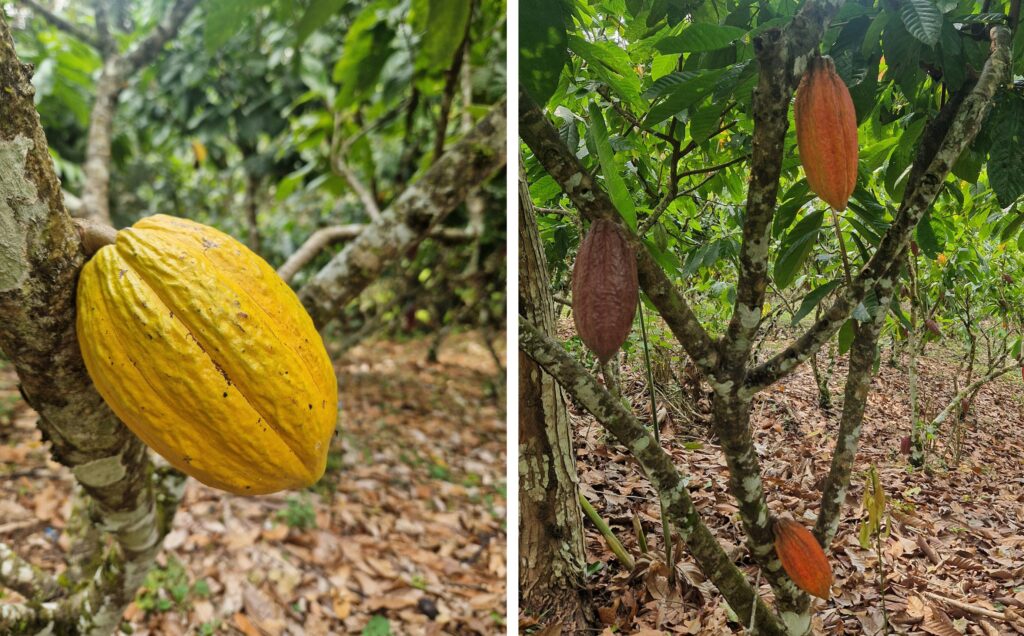
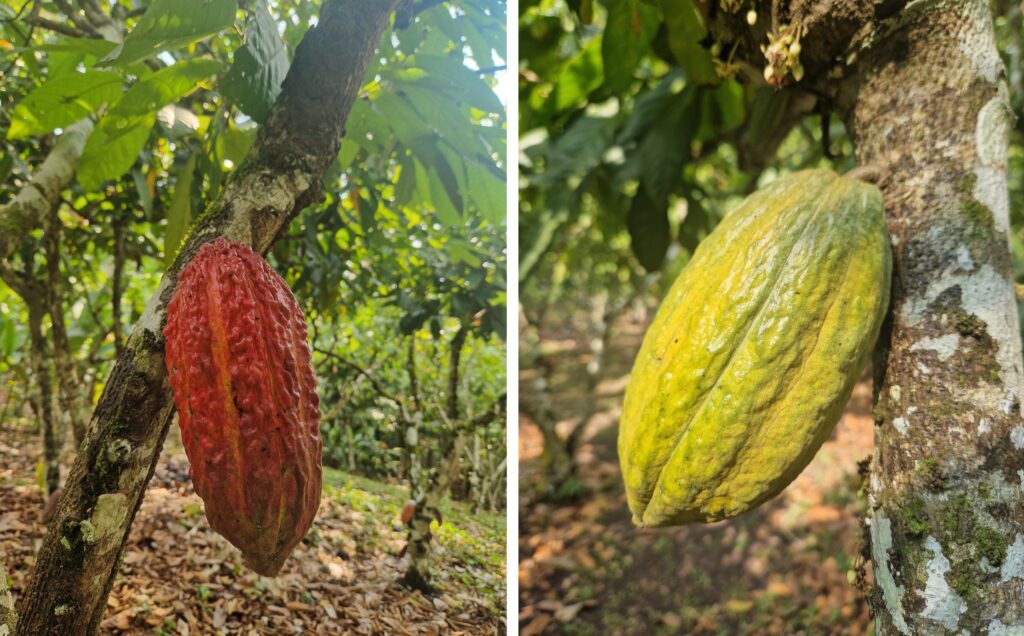
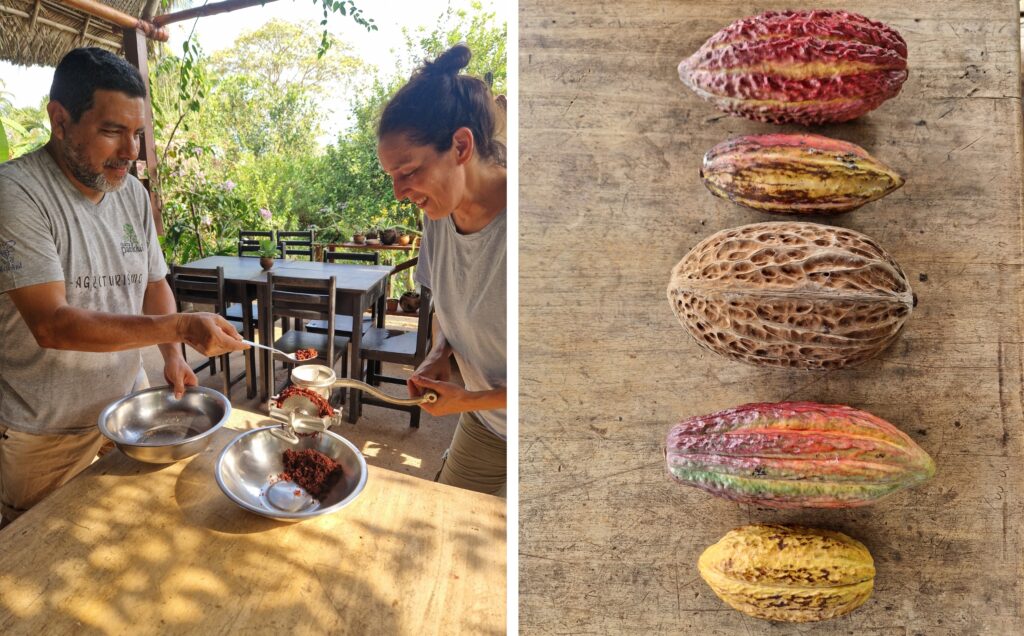
Cocoa pods of every color hang among the trees: deep green, bright yellow, rusty orange, purple, sometimes striped or spotted. Coco explains that this diversity is characteristic of Chazuta. Many trees have never been officially classified; they have been shaped and adapted to this landscape by generations of farmers. There are no uniform rows, but rather a living whole in which each tree follows its own rhythm.
I’m handed a machete. With a few quick taps, a cacao pod splits open, revealing white beans encased in a jelly-like pulp. I taste a bean and detect aromatic notes of lychee and citrus. Coco explains that everything here is put to use: the beans for chocolate, the pulp for juice or syrup, the shells for tea, and the rest for compost. In this system, there is no waste.
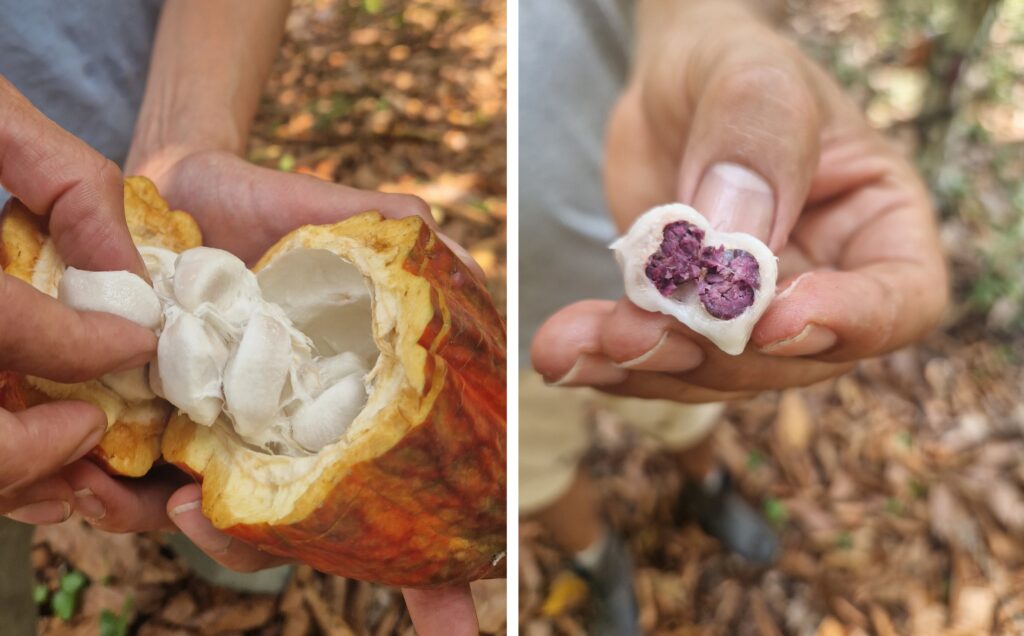
Katinka: “I taste a bean and recognize the aromatic flavors of lychee and citrus.”
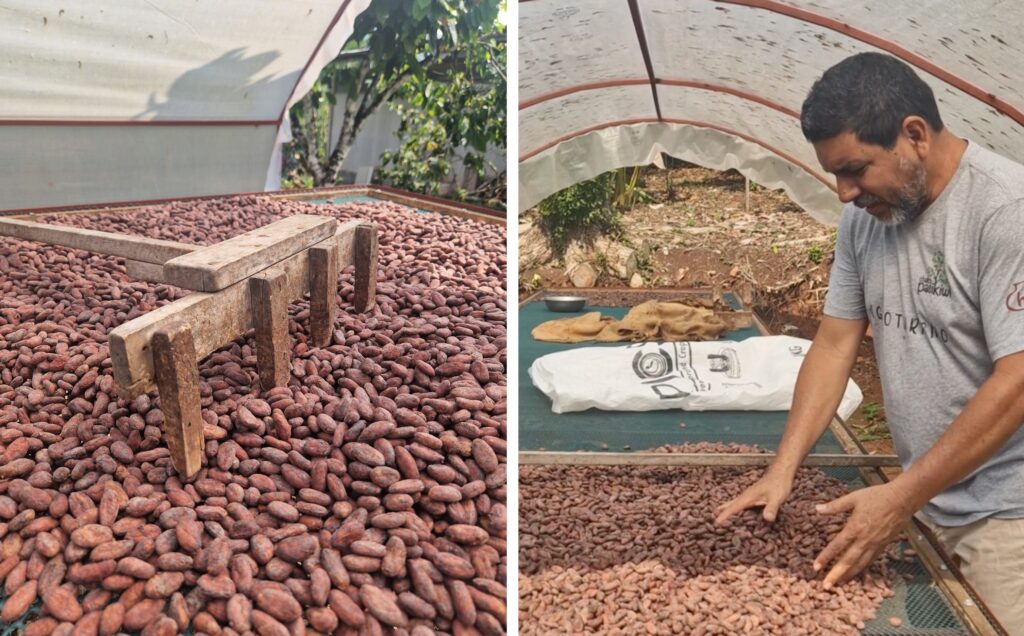
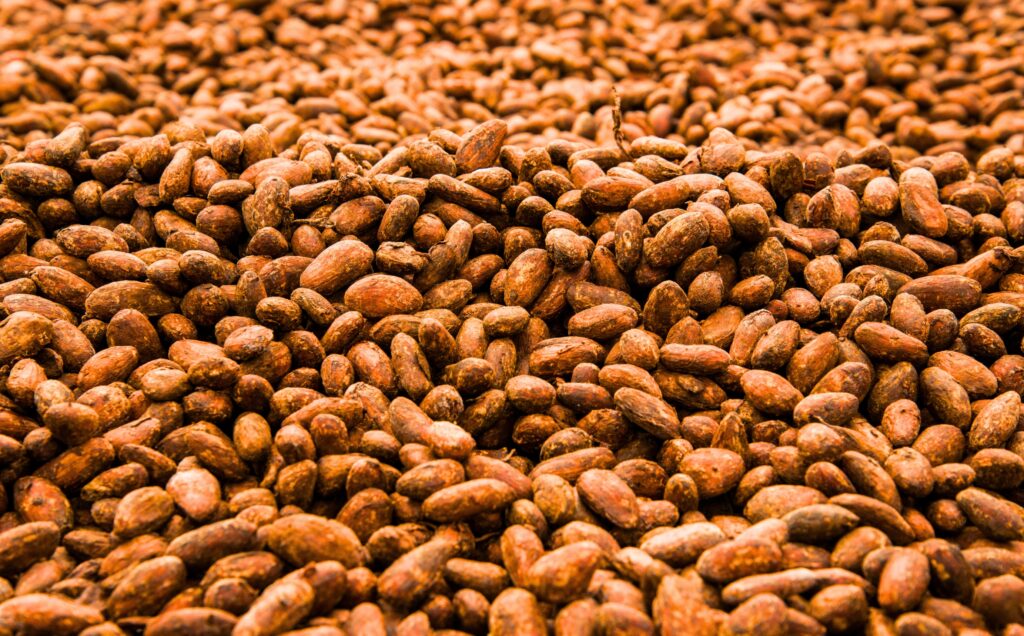
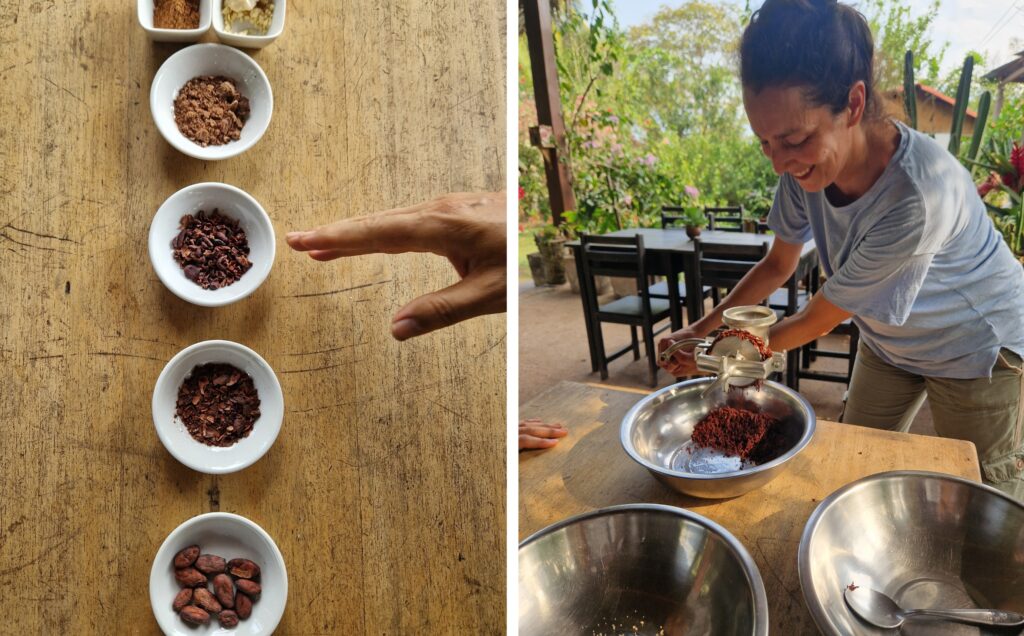
After harvesting, the beans are placed in large wooden fermentation bins, covered with banana leaves that retain the heat. Five to seven days later, they are spread out on drying beds under a translucent roof. For two weeks, they are turned daily with a rake, while their aroma and flavor evolve from fresh and fruity to deep and complex. Only then are the beans roasted and cracked into cacao nibs, the basis of chocolate.
By the end of the morning, I realize that in just a few hours I’ve seen the entire process of chocolate-making. From tree to bean, done entirely by hand and in small batches.
Among the cacao trees, small native bees—abejas—buzz about, producing aromatic honey. For Coco, agroforestry isn’t just a farming technique—it’s a way of life. A cacao tree never exists in isolation; the ecosystem around it determines its health, yield, and ultimately its flavor. The farmer, too, is part of that system—not the other way around.
Chakra Pasakiwi is more than just a farm. Schoolchildren come here to learn about bees and the forest, travelers take chocolate-making workshops, and families from Lima order cacao products that take days to arrive. Chefs also come here to select beans. This form of cacao tourism generates income without straining the ecosystem, and the money stays within the community.
Coco doesn’t believe in large-scale agriculture, but rather in small farmers working together. In organic cooperatives, they share knowledge, help each other when there are diseases or crop failures, and collectively set fair prices. Chazuta remains a poor region, but for the first time in a long while, cacao offers economic hope.
In Chazuta, agriculture is guided by the lunar calendar. Harvesting cacao, cutting palm leaves, and felling trees have followed the rhythm of the moon for generations. According to Coco, harvesting at the wrong time affects fermentation, attracts insects, or makes the wood more susceptible to mold. What may sound mystical to outsiders is everyday practice here, based on centuries-old knowledge.
Twenty years ago, many young people left Chazuta. For years, cacao had been grown here as a monoculture, which depleted the soil and made agriculture an unreliable source of income. The return to cacao, combined with other plants and trees, brought about change. Biodiversity increased, the soil recovered, and incomes became more stable. More and more young people are returning to help rebuild life here. Coco expects that their children, who are currently studying in Sweden, will one day return to their homeland as well.
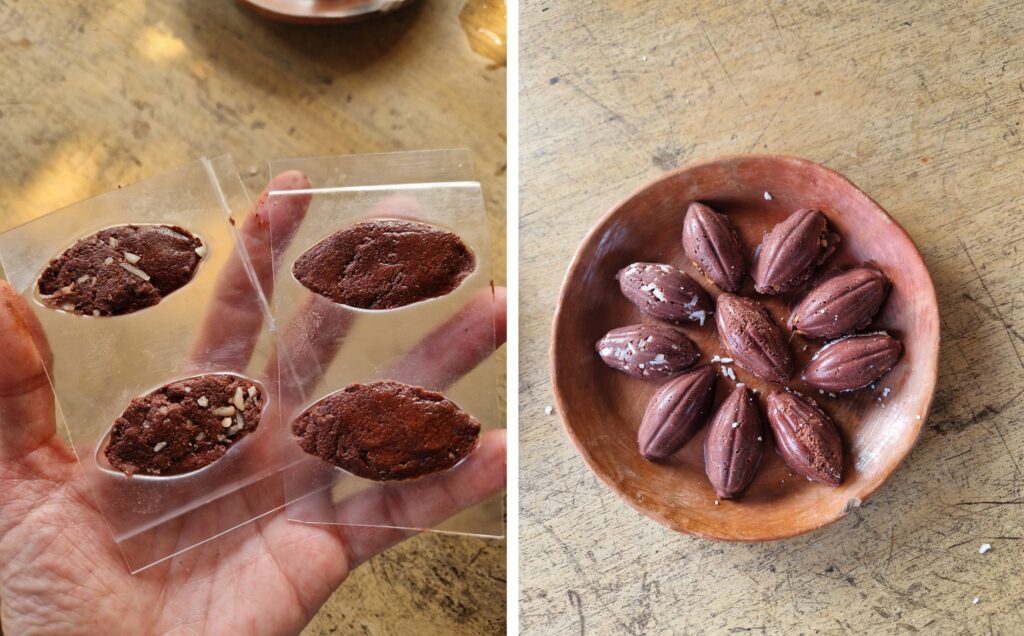
After the beans have been roasted and cracked, the next phase begins: from raw cacao to chocolate. The cacao nibs are ground in a batan, a traditional stone mortar. The friction and heat slowly transform the powder into a liquid paste. Coco adds honey, which dissolves immediately. The warm mixture is spread out on a cool stone and scraped back together. This process is repeated several times until the texture is just right (tempering). The chocolate is then poured into wooden molds and left to rest for a few days to develop its flavors.
Coco: “Nature always has time. The question is whether we take it.”
On my second day, I get to make my own chocolate. I experiment with chili, dried orange peel, salt, nibs, and sugar. While the chocolate sets, we drink fresh cacao juice—light, tropical, and almost lychee-like. Not everything turns out right: the version with too much salt is inedible, but I’m proud of the rest of the results. The flavor of cacao from Chazuta is completely different from industrial cocoa powder. Whereas the latter is often bitter and flat, here I taste fruit, flowers, nuts, and spices. The flavors are layered and vibrant. You can taste the landscape.
On my last day, the food forest smells of fermented cacao, wet leaves, and earth. I’m taking away more than just knowledge about fermentation or agroforestry. I’m taking away a different way of seeing things—one that’s slower and more mindful.
As I’m leaving, I’m given some cocoa syrup and fresh cocoa juice to take with me. “Nature always has time,” says Coco. “The question is whether we’ll take it.”
Katinka Lansink Dodero is a Peruvian-Dutch chef. Under the name cevicheceviche, she introduces the Netherlands to the flavors of Peru. She writes cookbooks and articles and organizes culinary events.











Arabica, Robusta, Bourbon, Gesha, or SL28: the plant names on a coffee bag reveal something about the variety, flavor, and origin.

Is a lot of foam a sign of good matcha? Not necessarily.

This bright green tea powder comes from a remote mountain community in China and is perfect for tea and (iced) matcha lattes.


