


Laatst bijgewerkt op: 17/08/2026
CHAPTER 9
When discussing matcha, people often talk about usucha and koicha as if they were two degrees of the same thing—thin and thick, light and heavy. In reality, they are two fundamentally different preparations, each with its own technical requirements and flavor objectives.
The difference between usucha and koicha isn’t just a matter of the amount of water or powder. It has to do with leaf selection, processing, grinding, and even the purpose for which matcha is intended in the first place. Anyone who understands that difference will view matcha differently and use it more thoughtfully.
The information in this article is based on the practical experience and teaching materials of Richard Schukkink, founder of the International Tea and Coffee Academy.
This article is part of the Matcha dossier. The complete overview of all articles, from cultivation and processing to brewing and applications, can be found on the overview page: Matcha explained: from tea leaf to bowl.
Usucha literally means “thin tea.” It is the most common way to drink matcha, both in and outside of Japan. The matcha is whisked with water to create a liquid beverage with a fine foam.
Koicha means “thick tea.” Here, matcha is mixed with a much smaller amount of water to form a syrupy substance without foam. The flavor is concentrated, intense, and immediate.
Although both styles stem from the same tradition, they place entirely different demands on the matcha itself.
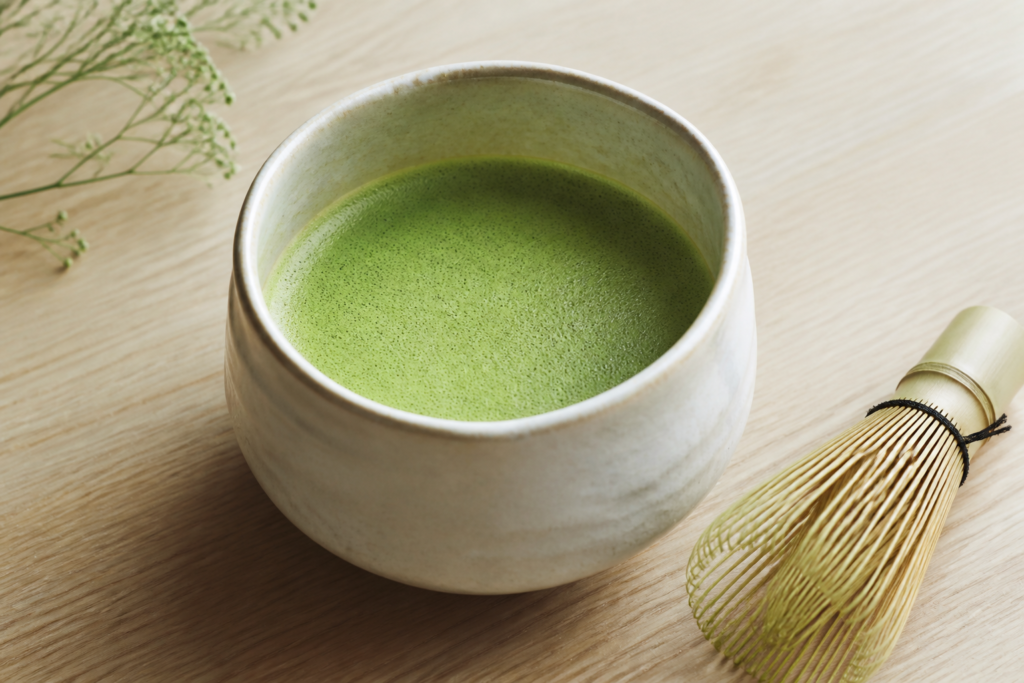
Usucha is meant to be fresh, lively, and well-balanced. The matcha should have enough umami to maintain its depth, but it may also exhibit a slight bitterness or a fresh, green note.
Typical characteristics of matcha used for usucha:
Usucha allows for more variation in water, temperature, and the whisking technique. As a result, this style is more accessible for everyday use and has a wider range of applications, even outside the formal tea ceremony.
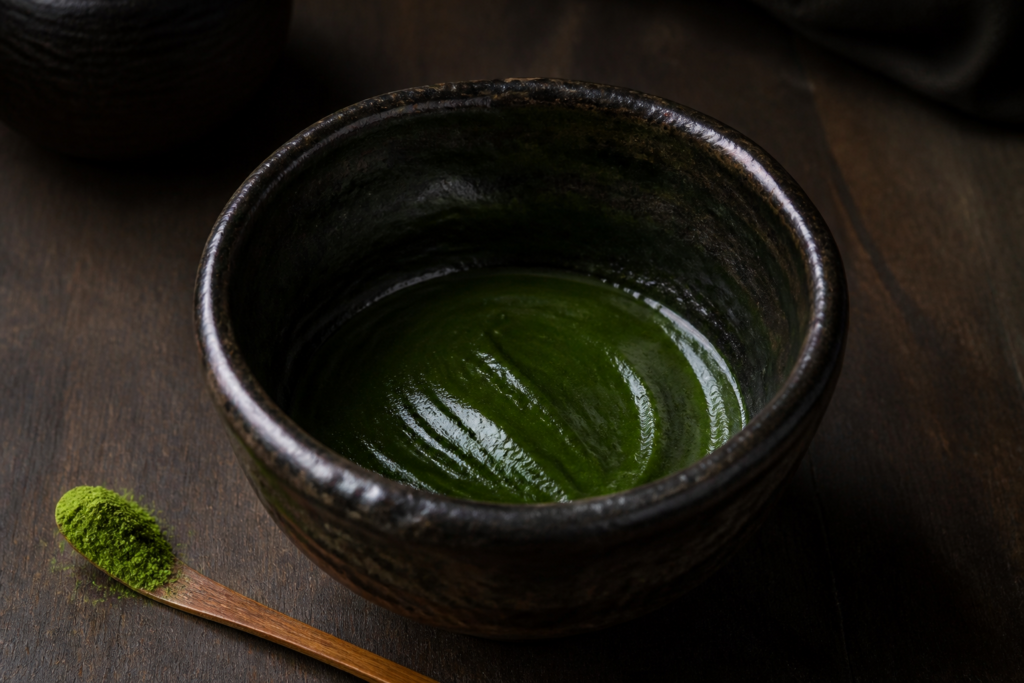
Koicha is unforgiving. Because the matcha is consumed in high concentrations, any imbalance becomes immediately apparent. Bitterness has nowhere to go. Astringency is immediately noticeable.
Matcha suitable for koicha must therefore:
Many matcha varieties that work well in usucha fall short when used in koicha. This isn’t a quality issue, but rather a mismatch between the product and its intended use.
For koicha, leaves from very early harvests are often used, sometimes sourced from older plants or specially selected sections of the field. These leaves typically contain:
Usucha can be made from a wider selection of ingredients. This increases production volume and makes the styles more diverse.
So these differences don’t begin in the bowl, but in the field.
Koicha has higher requirements for grinding than usucha. Because the powder is used in high concentrations, it must be extremely uniform. Even slight variations in particle size can be felt as graininess or resistance.
Matcha for usucha can have a little more variation, as long as the foam remains stable and the mouthfeel doesn’t become thin.
Here, once again, you can see that style and technique reinforce each other. Koicha demands perfection in the earlier steps.
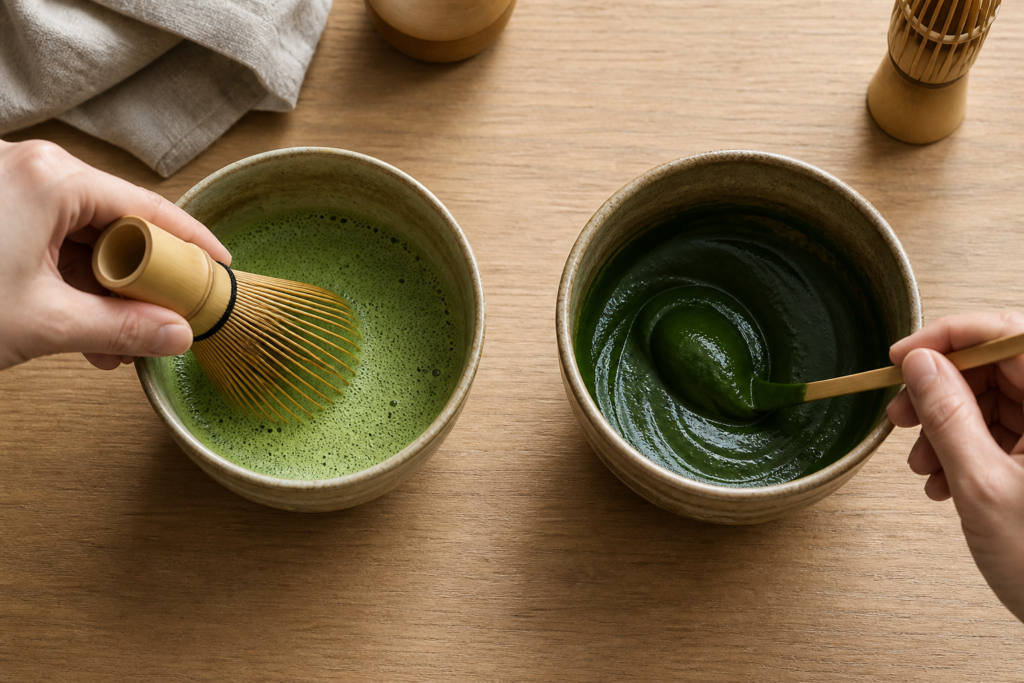
The difference in preparation reflects the difference in purpose.
In usucha, air is whipped into the tea. The foam softens the bitterness and releases the aromas. The motion is quick and rhythmic.
In koicha, no air is incorporated. The motion is slow and controlled—more like stirring than whisking. The goal is a glossy, smooth mixture without any bubbles.
If you try to whisk koicha the same way you would usucha, you won’t get a better texture—in fact, you’ll end up with a worse one.
Usucha:
Koicha:
These differences aren’t just a matter of personal preference. They require a different mindset when tasting. You don’t drink koicha to quench your thirst, but to savor the experience.
It is sometimes suggested in the market that “higher-quality” matcha is automatically suitable for koicha. That is not true. Suitability for koicha is not an end in itself, but a specific characteristic.
Matcha can:
That makes classification difficult, but a user-centered approach is essential.
These differences remain relevant even outside the formal tea ceremony. In modern applications, you can find koicha-like concentrations in desserts, sauces, and pastries.
The same requirement applies there: intensity without sharp bitterness.
In the following articles, we’ll take a closer look at how foam, style, and tasting are related to these choices.
This article is part of the Matcha dossier. The complete overview of all articles, from cultivation and processing to brewing and applications, can be found on the overview page: Matcha explained: from tea leaf to bowl.
















In Amsterdam's Pijp neighborhood, Duikelman proves that expertise, service, and inventory still make all the difference.

Arabica, Robusta, Bourbon, Gesha, or SL28: the plant names on a coffee bag reveal something about the variety, flavor, and origin.

Is a lot of foam a sign of good matcha? Not necessarily.


