


Gepubliceerd op: 06/04/2021
Costa Rica has been growing coffee for more than two hundred years and has eight official coffee-growing regions. One of the most notable is Turrialba. Although attention usually focuses on the nearby and larger Tarrazu region, the “forgotten coffee region” of Turrialba has the longest harvest season in the country. Thanks to heavy rainfall and favorable temperatures, coffee plants can even bloom up to ten times a year. Q-grader Norman Mazel and Joffrey Vermeule, owner of Zwartekoffie, shed light on this Costa Rican coffee region.
Turrialba is the name of the small town, the volcano, and the district in the province of Cartago, located in the central northeastern part of the country, toward the Caribbean Sea. The region is about an hour and a half’s drive from San José, the capital of Costa Rica, at an elevation of 600 to 1,400 meters above sea level—an ideal elevation for growing coffee.
A major attraction in the region is the active volcano Turrialba. It stands a whopping 3,340 meters tall and rumbles regularly. From the summit, you can see both the Caribbean Sea and the Pacific Ocean. The Irazú volcano also lies just within the province and owes its nickname, “the colossus,” to the fact that it is the country’s largest and most active volcano.
Turrialba is one of the rainiest regions in all of Costa Rica. It rains an average of 2,600 millimeters per year. By comparison, the Netherlands receives an average of 800 millimeters of rain per year. As a result, the dry season is virtually indistinguishable from the wet season. The rainfall contributes to high-quality coffee production. The temperature, averaging 21.5 °C, is also favorable. Coffee grows best at an average temperature of 18 to 21 °C.
Thanks to the favorable microclimate, the harvest season in Turrialba is much longer than in other Costa Rican coffee-growing regions. The harvest begins as early as June and continues through January/February. The coffee beans are, on average, larger than usual, and the coffee plants can bloom up to ten times a year. This makes growing coffee in this region labor-intensive: coffee farmers sometimes have to tend to the same coffee bush as many as ten times.
There are approximately 2,400 coffee farms in Turrialba, which account for just over five percent of Costa Rica’s coffee production. Costa Rica has about 340 million coffee plants, more than 17 million of which are located in Turrialba. The country has a specific method for weighing and measuring coffee. This is not done by weight, but by volume. When the berries are picked at full ripeness, they are larger and heavier, which means the farmer receives a higher price for them. It’s a good way to encourage farmers to harvest carefully!
Traditionally, Caturra and Catuaí have been widely cultivated. Other varieties include Venecia, Costa Rica 95, T5296, Obatá, and Centroamericano (a cross between T5296 and the Ethiopian Rumi Sudan). The T5296, Venecia, and Costa Rica 95 varieties were developed at the CATIE research institute, which is located in Turrialba itself.
It is interesting to note that the cultivation of Robusta is prohibited by law in Costa Rica. The Costa Ricans do not want to compromise their long-standing reputation for high quality. However, due to climate change and Arabica varieties losing their strength, interest in introducing Robusta is growing. Although proponents are still in the minority, the first trials with Robusta are already underway.
Thanks to the Turrialba volcano, the soil is rich in magnesium, calcium, and zinc—all essential nutrients for plants. The volcano therefore has a positive influence on the coffee’s flavor. The body is usually quite light and smooth, the acidity normal to mild, and the aroma mellow. Most of the coffee is traditionally washed. In addition, honey processing—the Costa Rican variation on the Brazilian pulped natural, is gaining popularity, partly to create greater flavor distinction and refinement.
Norman Mazel is a dual-certified Q-grader (for Arabica and Robusta). He is fascinated by the many varieties of coffee and has been working for some time to compile “all” of them into one comprehensive overview. Another project is creating a clear chart of the various processing methods and their variations.
Joffrey Vermeule is the owner of Zwartekoffie, through which he sources coffee directly from farmers in the Turrialba region. Joffrey himself lived in Turrialba for two years with his wife and two children. During that time, he discovered that this “forgotten” region produced high-quality coffee. Now, from the Netherlands, Joffrey sources coffee from eighteen different farmers, and that number is growing every year.
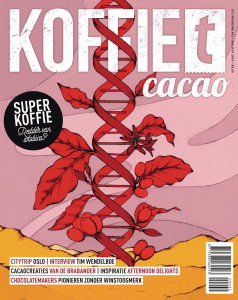
This very first installment of the “Coffee Region” column appeared in koffieTcacao 32. In this fall issue, Willem Boot reveals all about those new F1 hybrid “super coffees” and how they are expected to secure the future of Arabica. They also discuss Chocolate makers Rodney Nikkels and Enver Loke are passionate about the quest for an independent cocoa supply chain. And in Amerongen, we take a look inside the large factory of Moccamaster, where every part of the iconic coffee maker has been assembled by hand (and with the utmost precision) every day for 55 years.



















According to Spencer Hyman, founder of the artisanal chocolate platform Cocoa Runners, we need to learn to eat chocolate differently.

Yerevan is best known for its rich history, but is developing into a surprising destination for specialty coffee. On this city trip to the Armenian capital, you’ll discover hidden roasteries, modern coffee bars, and a traditional tea house.

From higher Fairtrade prices and coffee beans for home use to an exhibition on coffee and colonial history: here's what's happening in September.


