


Laatst bijgewerkt op: 06/07/2026
At Finca San Isidro in Huila, Colombia, coffee grows among shade trees on the slopes around La Plata. Thousands of kilometers away, that same coffee is served at a private bar in Zwolle. There are no longer long chains of middlemen between the plantation and the cup, but rather two families who became connected through adoption. What began as a personal quest grew into an effort to take control of the coffee supply chain themselves.
Carlos Andres Perdomo Rojas (25) grew up among the coffee trees. On his family’s fincas in Huila, he watched his parents and grandparents sow, harvest, process, and dry the coffee. “Coffee has always been a part of my life,” he says. “For years, it was simply our way of life, not something I had consciously chosen.” That changed when he began to explore specialty coffee: coffee that isn’t just sold as a commodity, but is judged based on its origin, processing, and flavor.
Carlos: “Quality starts with respect for the land, the coffee trees, and the people who work with us”
Carlos saw a future in that—not by leaving the family business behind, but by carrying it on in a different way. He now represents the fifth generation of the Rojas family. “My father and grandfather taught me that quality begins with respect,” he says. “Respect for the land, the coffee trees, the people who work with us, and the time it takes to do something right. If you take a shortcut, you’ll eventually taste the difference in your cup.”
The fact that the name Rojas now appears on coffee bags and a building facade in Zwolle all started with the Blom family. Their oldest son, Rafael, was born in Colombia and was adopted as a baby by Corine Blom and her husband, Marco. Years later, when the family set out to find his biological mother, that search led them to La Plata. The Rojas family turned out to be his biological Colombian family. Carlos and Rafael are first cousins: their mothers are sisters.
Rafael himself doesn’t work in the coffee industry, but as a recent graduate with a degree in audiovisual studies, he will travel to Colombia this fall to spend time with his family and work there. Rojas plans to use the footage to tell the story behind the coffee more transparently through social media.
For Corine and her family, the encounter revealed a world that is easily hidden behind an ordinary cup of coffee. “In terms of nature, it’s a paradise on earth, but it’s no fairy tale,” she says of La Plata. The Rojas family has been growing coffee for generations, but sold it through cooperatives and various middlemen. “There are many middlemen in the trade, all of whom want to make a profit. That money doesn’t end up with the coffee farmers and their workers.” People worked hard on the plantations, yet little was left over to invest.
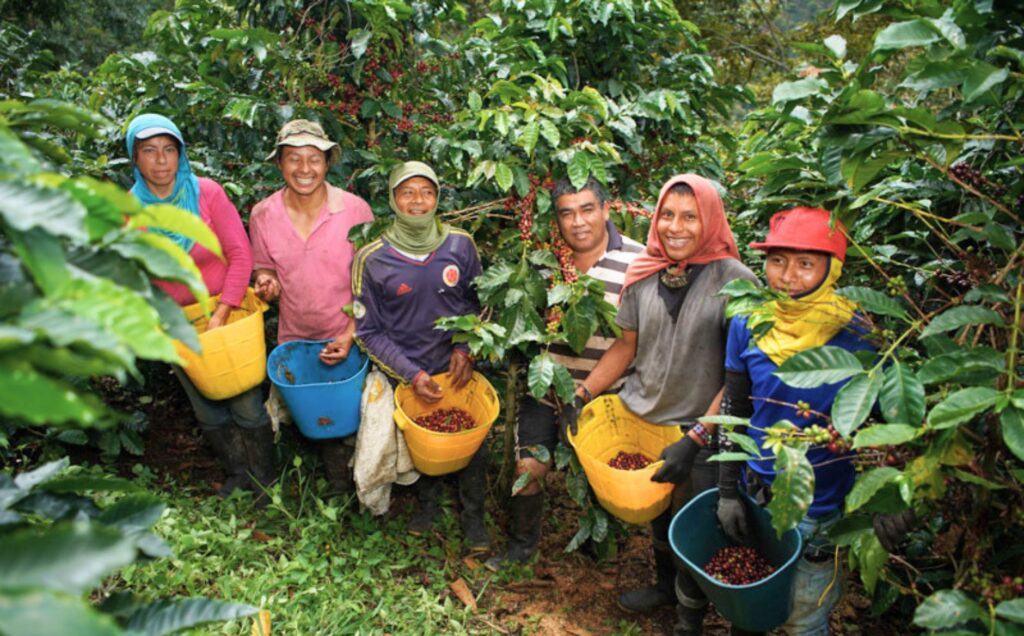
Corine: “In terms of nature, La Plata is a paradise on earth, but it’s no fairy tale”
In 2019, Carlos was staying in the Netherlands to learn English. Due to the COVID-19 pandemic, he was unable to return to Colombia for longer than planned. Together with Corine and her family, he used that time to set up his own import and export operation. “We boldly launched a direct-trade line,” Corine recalls. She soon discovered that importing coffee directly was less straightforward than it sounded on paper. Still, the two families persevered. That’s how Rojas Specialty Coffee came to be: the family in Colombia grows and processes the coffee, while the Dutch side handles imports, sales, and contacts with roasters and coffee shops.
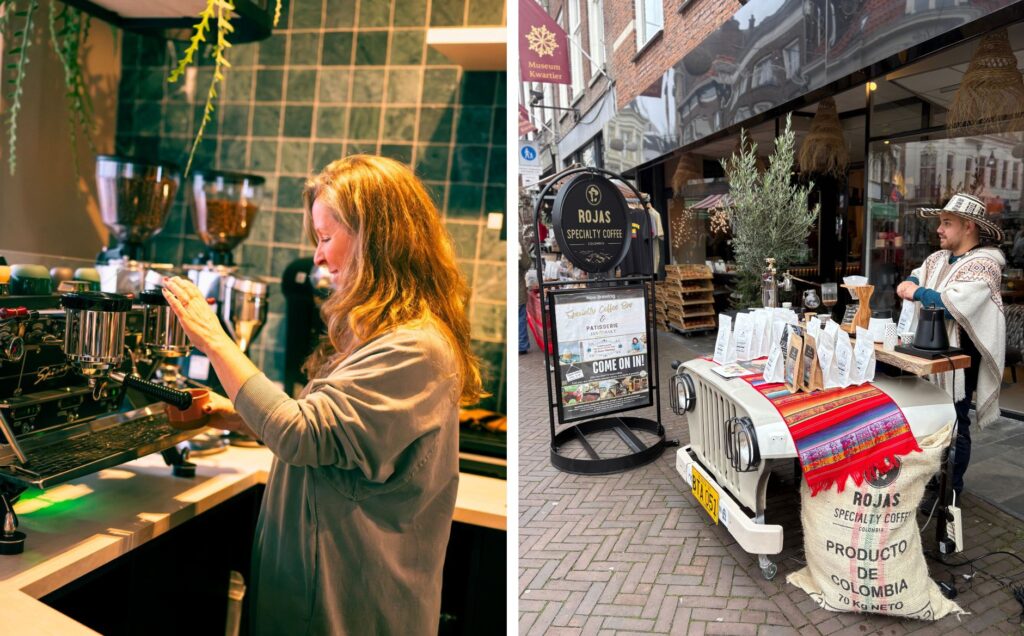
Rojas started small, with an online store for consumers and green—that is, unroasted—coffee for micro-roasters. The current import of 8,000 kilos of green coffee is stored in the company’s own warehouse. From there, Rojas roasts it fresh for its own coffee bar and for specialty coffee shops, businesses, offices, online store customers, and its own “flagship store.” Green beans are also shipped to coffee roasters in the Netherlands and Europe.
Carlos: “People wanted to know where the coffee came from, who had produced it, and how it had been processed.”
Carlos earned his SCA Intermediate Roast Certification in Cali and has been roasting his own coffee for about eight years. When Carlos is in the Netherlands, he roasts the coffee alongside Marco at Frans de Grebber Roastery in Meppel. When Carlos is in Colombia, Marco and Frans de Grebber handle the roasting at the roastery.
That’s what makes his position unique. Many roasters don’t get to know the green coffee until the bag is opened in the Netherlands. Carlos knows the same coffee from the tree, through the harvest, and into the fermentation tank. Yet it wasn’t just the technical aspects that caught his attention in the Netherlands. “I was surprised by the interest in the story behind the coffee,” he says. “People wanted to know where the coffee came from, who had produced it, and how it had been processed.” In Colombia, Carlos also learned to roast without a battery of computer screens. Observing, smelling, and listening to the bean are practical tools for him; in Meppel, those Colombian senses come together with Dutch roasting expertise.
The two family fincas each have their own distinct character. At San Isidro, varieties such as Bourbon and Gesha are grown. The Bourbon undergoes anaerobic fermentation—without oxygen—followed by a honey process. The result is a well-balanced coffee with an SCA score of 86. The Gesha scores 87 and has a more pronounced floral profile, with notes that the family describes as jasmine and lemongrass.
Palo Grande represents the experimental side of the family business. There, they work with varieties such as Tabi, Castillo, and Colombia, and use longer fermentation times. This can result in a fruitier, almost wine-like cup with higher acidity.
For anyone trying Rojas coffee for the first time, Carlos would recommend starting with San Isidro: an approachable and harmonious flavor profile that combines notes of chocolate, caramel, and yellow fruit. This coffee has a rich sweetness, a mild, refined acidity, and a creamy body.
The family processes coffee using the washed, honey, semi-honey, and natural methods. They particularly prefer the honey method because of the balance it brings to the cup. The natural method can produce rich flavors, but it requires a lot of work and, according to Rojas, has a more limited market. New experiments are also on their wish list, including thermal shock.
At Rojas, “direct trade” means that the Dutch and Colombian branches of the family make the arrangements directly. For the import price, the company uses the standard price set by the Colombian Coffee Federation, plus a premium. According to Corine, the family in Colombia knows the local minimum wage and Rojas chooses to pay coffee pickers a higher standard rate.
The increased yields are also reflected in the equipment. The fincas have added fermentation tanks and a pallet lifter, which makes it easier to move a full tank to the washing basin. During the harvest, about forty coffee pickers work at each plantation: so around eighty in total at San Isidro and Palo Grande. According to Rojas, this isn’t an increase compared to previous years, but rather the usual capacity required for the size of both fincas. Still, Carlos cites not a machine, but certainty as the biggest change. “Direct trade gives us more stability and confidence in the future,” he says.
Carlos: “Direct trade gives us more stability and confidence in the future.”
Remarkably, the next step was not a larger export shipment, but opening their own coffee bar in La Plata. That bar provided the family with a steady source of income and a place to showcase, right in their own region, what five generations of coffee expertise can achieve. This was followed by a second location at the Mocca Mirador lookout point. On July 20, 2025, a third Rojas Specialty Coffee Bar opened in the historic downtown area of Zwolle, at 25 Luttekestraat. That date was chosen deliberately: July 20 is Colombia’s Día de la Independencia, Independence Day. For the first time, the coffee could also be tasted at a dedicated shop on the Dutch side of the family line.
Carlos wants to reach more coffee drinkers in the coming years, but for him, growth isn’t just a matter of selling more bags. “We don’t just want to share coffee from our own family,” he says. “We also want to create opportunities for other coffee-growing families in our region.” His ambition is to help neighboring producers gain access to the specialty market. They often have the knowledge and suitable terroir, but lack the contacts, language skills, or resources to market their coffee internationally on their own.
For readers who would like to get a sneak peek at the fincas, there is a short video about San Isidro and Palo Grande



















According to Spencer Hyman, founder of the artisanal chocolate platform Cocoa Runners, we need to learn to eat chocolate differently.

Yerevan is best known for its rich history, but is developing into a surprising destination for specialty coffee. On this city trip to the Armenian capital, you’ll discover hidden roasteries, modern coffee bars, and a traditional tea house.

From higher Fairtrade prices and coffee beans for home use to an exhibition on coffee and colonial history: here's what's happening in September.


