


Laatst bijgewerkt op: 20/04/2026
In the ‘On the Test Bench’ section, we test machines, grinders and gadgets, ranging from large to small and from cheap to expensive. This time, Paul Tinhout from the International Tea & Coffee Academy, together with his students, is testing the WMF Espresso Pro. In this WMF Espresso Pro review, you can read his findings.
WMF has been a household name in the coffee world for decades, with a strong presence in both the hospitality sector and the consumer market. With the WMF Espresso Pro, the brand is specifically targeting the home market and small office environments, whilst offering features typically found on more expensive machines. In this review, we look at ease of use, consistency, learning curve and the machine’s limitations in practice.
Upon unpacking, it is immediately apparent that the WMF Espresso Pro is robustly and thoughtfully built. The housing feels solid, the buttons are responsive, and the interface looks modern and user-friendly. The warm-up time is remarkably short. The machine is ready for use within a few minutes, which is a major advantage in a home setting or small office.
For this WMF Espresso Pro review, we’re using a washed Nicaraguan coffee, medium roast. A coffee that lends itself well to assessing balance, extraction and clarity. During grinding, the display automatically shows the weight of the ground coffee. This is a feature typically found on high-end machines. When checking the weight with a precision scale, we see a deviation of just 0.1 to 0.2 grams. For most home users, this is more than accurate enough.
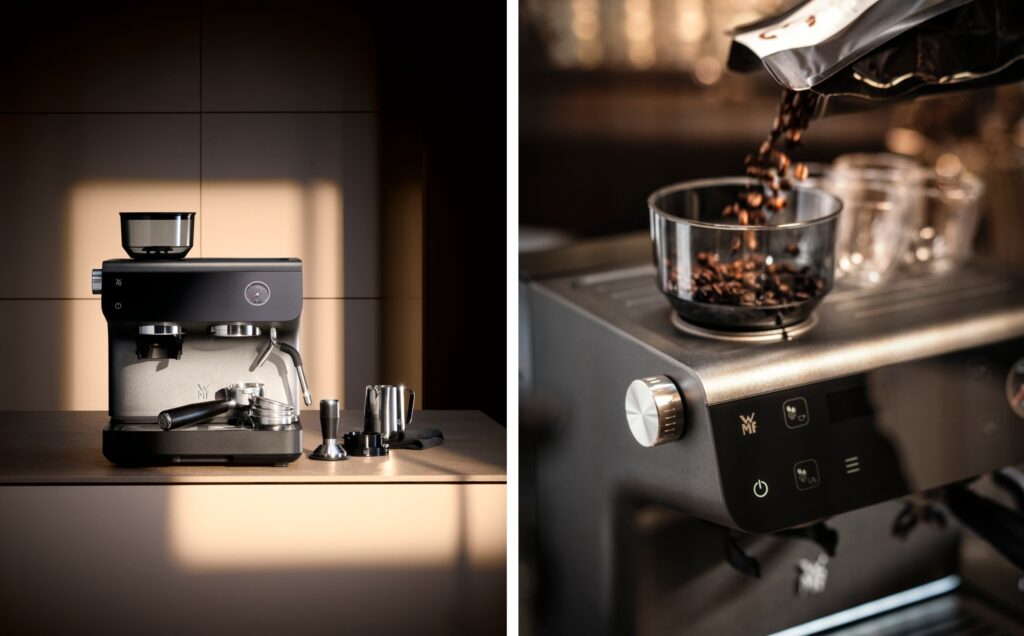
Although the display shows the ground weight, it is not possible to set the dose directly in grams. You cannot, therefore, instruct the machine to grind, say, 18 grams of coffee. Instead, you set the grinding time. The machine will then display the weight of the coffee ground within that set time. This is common in this price range, but in this WMF Espresso Pro review, it remains an important consideration for users seeking maximum control and reproducibility.
On to the perfect espresso. Our aim is an espresso made from 18 grams of coffee with a brew time of between 23 and 26 seconds. The machine is set to 45 ml of water and a 2-second pre-infusion. After about 15 minutes of experimenting with these settings, we produce our first espresso, which is technically balanced but doesn’t quite hit the mark flavour-wise.
By then lowering the temperature by one degree and reducing the water volume by 8 ml, everything falls into place. The espresso takes on a clearer structure and greater definition. The flavour profile reveals notes of milk chocolate and orange, with a gentle caramel finish. The body is medium to full, and the extraction is clean, clear and balanced.
The built-in grinder has 60 settings. During testing, it became apparent that the optimal espresso setting is on the fine side, around setting 4. This means the grinder is operating close to its finest setting, which in practice means we still need to use a separate set of scales to check the dose accurately. If the grinder grinds just a little too much coffee, this is easily corrected by removing a small amount to arrive at exactly 18 grams. For many users, this will be perfectly workable, but for purists who want to grind strictly by weight, this is a point to bear in mind in this WMF Espresso Pro review.
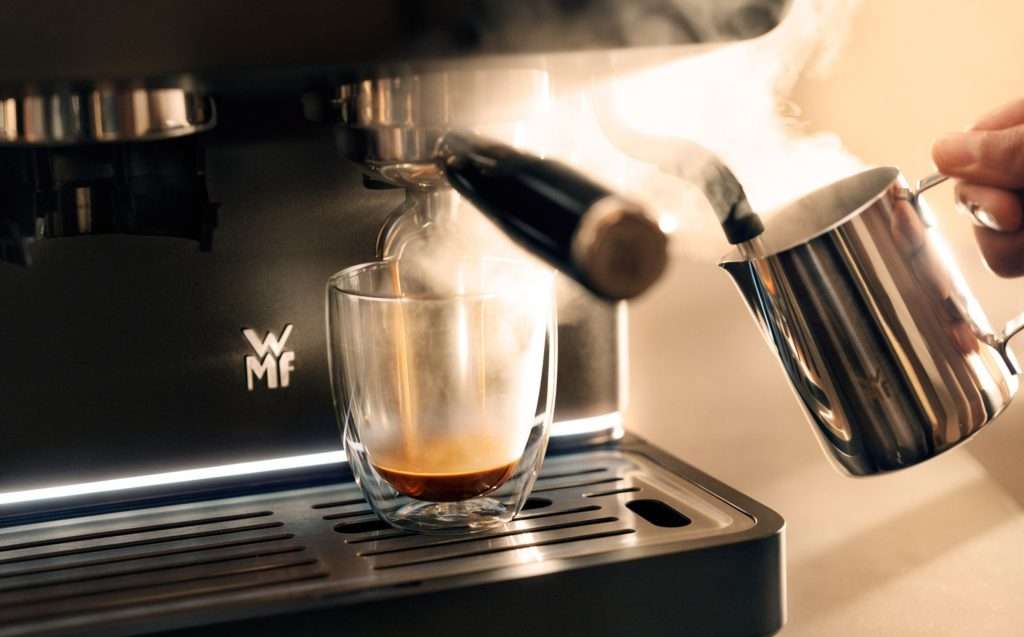
Once the espresso is coming out of the machine properly, we’ll move on to milk-based drinks. The WMF Espresso Pro comes with a compact steam wand and makes a surprisingly strong impression in this regard. The steam power is remarkably good for a machine in this price range and makes it possible to create silky-smooth microfoam with little effort. This foam is not only suitable for simple latte art, but above all for the consistent preparation of cappuccinos and other milk-based drinks.
The steam output feels different from that of professional catering machines. It is slightly gentler, yet stable and highly predictable. It is precisely this that makes steaming accessible to users without extensive barista experience. After just a few attempts, students were already clearly in control of the foam and were soon able to achieve consistent results.
We’re testing how the WMF Espresso Pro handles decaf with another group of students. We’re using a CO₂-decaf coffee. With decaffeinated coffees, we often find that a finer grind is needed to achieve a good extraction, as the beans react differently during grinding and brewing compared to regular coffee.
In this case, the grinder quickly reaches its limit. Even at the finest grind setting, the espresso runs through in around 16 seconds. We try to correct this by increasing the dose to 21 grams, but this offers little improvement. The portafilter fills up quickly and the extraction time remains stuck at around 19 seconds. The result is an espresso that feels thin, is under-extracted and shows little complexity.
As soon as we switch back to regular caffeinated coffee, the machine is properly calibrated again within ten minutes and we’re producing a balanced espresso once more. This makes it clear that it is not so much the brew group or temperature stability that is the limiting factor, but primarily the grind range of the grinder when it comes to decaf.
The machine performs exceptionally well in everyday use. Key strengths highlighted in this review include the quick heat-up time, the smooth workflow thanks to the dosing funnel, the clear feedback via the display, and the adjustable settings such as temperature and pre-infusion.In dagelijks gebruik scoort de machine sterk. Pluspunten die in deze review duidelijk naar voren komen zijn de snelle opwarmtijd, de nette workflow dankzij de dosing funnel, de duidelijke feedback via het display en de instelbare parameters zoals temperatuur en pre-infusie.
What’s missing is a dust tray. For home use, this is an accessory that really ought to come as standard.

The WMF Espresso Pro is an accessible, robust and user-friendly semi-automatic espresso machine for coffee enthusiasts. The machine is particularly suited to users who want to learn how to adjust settings and seek greater control than is offered by entry-level models. Its steam performance is excellent and, when properly calibrated, the espresso results are consistent and full of flavour.
Its limitations include the lack of weight-based grinding, the limited grind range for decaf, and the absence of a drip tray. However, for lovers of espresso and cappuccino made with regular coffee beans, the WMF Espresso Pro offers excellent value for money.
















Coffee and tea experts share seasonal recipes and practical ideas for restaurant menus. The workshops take place at a pick-your-own garden in Stoutenburg.

These classic madeleines from The Art of Baking by Hidde de Brabander combine a soft texture with a rich buttery taste.

In this article, we debunk 10 persistent fables and myths about coffee. From caffeine to Kaldi and from oil to dehydration. What is really true, and what is mostly a persistent misconception?


