


Laatst bijgewerkt op: 04/06/2026
CHAPTER 3
As with drinks like coffee and wine, you can see provenance as more than just background information with matcha. Because you drink the whole leaf, everything that happens during the plant’s growth becomes directly part of what you taste. Climate, soil, microclimate and human intervention combine to shape the flavor profile in your cup.
Terroir is therefore not a romantic concept with matcha, but a practical reality. It explains why two matchas with the same cultivar, same shade duration and even similar processing can nevertheless feel completely different.
The explanations in this article are based on the teaching materials and practical experience of Richard Schukkink, founder of the International Tea and Coffee Academy.
This article is part of the Matcha dossier. The complete overview of all articles, from cultivation and processing to brewing and applications, can be found on the overview page: Matcha explained: from tea leaf to bowl.
Terroir describes the interaction between environment and plant. In matcha, that environment consists not of a single factor, but of a set of conditions that reinforce or weaken each other.
Key components are:
Because matcha is not extracted but fully consumed, these factors are especially palpable. Bitterness, umami, color and mouthfeel are not abstract qualities, but direct translations of these conditions.
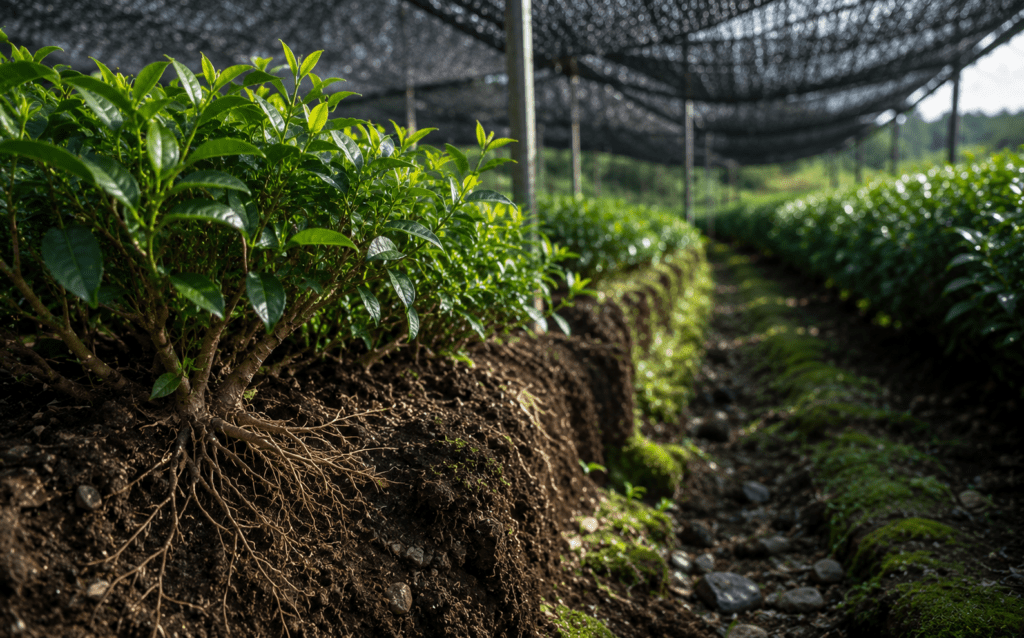
Climate determines how fast a tea plant grows and the stress it is under. Cooler springs often lead to slower growth. That gives the plant more time to build up amino acids, which can be beneficial for umami and smoothness.
In warmer areas, growth is faster. This can lead to:
It is not necessarily worse, but it is different. Heat affects the balance between amino acids and catechins, and thus the ratio of umami to bitterness.
Importantly, climate always interacts with other factors. A cool area with poor soil does not produce top matcha, any more than a warm area with excellent management automatically produces inferior quality.

With tea, people often talk about sour bottoms. That’s true, but it says little without context. For matcha, soil quality is all about structure, drainage and nutrient availability.
Tea plants generally do well in slightly acidic soils, often around a pH of about 4.5 to 5.5. Too acidic can cause stress and mineral problems. Too basic can limit the absorption of certain micronutrients.
In addition, soil type plays a role:
Soil affects not only flavor, but also how well a plant can tolerate shade. Healthy soil helps the plant cope with controlled stress.
The location of a field determines how wind, sun and moisture behave. Fields on slopes often dry faster after rain, which can reduce disease pressure. Sheltered areas, on the other hand, retain more moisture, which can be beneficial during drier periods but pose risks during prolonged precipitation.
Small differences in altitude or location can lead to noticeable differences in leaf texture and aroma. This explains why even within one region matchas can vary.
Terroir is thus not only regional, but often local.

Japan has several areas known for matcha production. Those names are often used as quality labels, but only say something if you understand what is behind them.
Uji, in the Kyoto region, is historically considered the heart of classic matcha. Its relatively cool climate, long tradition of shade cultivation and focus on umami have led to a style often associated with depth and tranquility.
Nishio, in Aichi, is an important modern production area. The climate is slightly warmer and drier, the fields tend to be flatter and production more mechanized. Nishio matcha is known for consistency and reliability.
Kagoshima, on Kyushu, has a warmer and sometimes subtropical climate. Volcanic soils are common here. Matcha from this region can be powerfully green, fresh and energetic, and is widely used in export markets.
Shizuoka and Mie produce less matcha than sencha, but experiment with new cultivars and styles, sometimes leading to distinct, modern profiles.
None of these regions is necessarily better. They just require different choices.
A common mistake is to separate cultivar from origin. A cultivar known for deep umami in Uji may give a very different profile in a warmer region. Conversely, a modern cultivar may actually perform surprisingly well in a classic region.
Terroir and genetics work together. You cannot judge one without including the other. That also explains why name alone is never enough information.
Terroir is not just nature. With matcha, human intervention is at least as decisive. Shade duration, pruning, nutrition and harvest timing are an integral part of terroir.
Two farmers on the same soil can still make completely different matcha due to different choices. So terroir is not a fixed datum, but a dynamic system.
In the marketplace, terroir is sometimes used as a decorative term. With matcha, that doesn’t work. The differences are too direct, too palatable and too consistent.
Anyone who tastes matcha seriously will recognize patterns:
Terroir helps understand those patterns, not capture them.
Terroir in matcha, then, is anything but abstract. It is the sum of climate, soil, location and human choices. Because you drink the whole leaf, that sum translates directly into taste, color and mouthfeel.
In the following articles, we look at how these terroir choices come together with cultivar and processing, and how they ultimately determine the taste of what’s in your bowl.
This article is part of the Matcha dossier. The complete overview of all articles, from cultivation and processing to brewing and applications, can be found on the overview page: Matcha explained: from tea leaf to bowl.











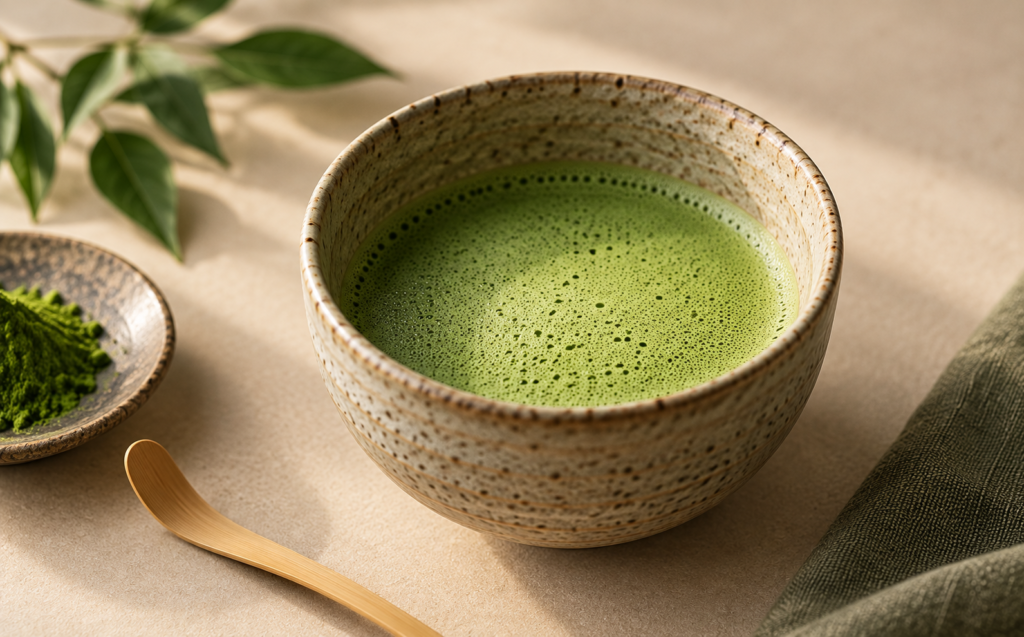


This bright green tea powder comes from a remote mountain community in China and is perfect for tea and (iced) matcha lattes.

Coffee and tea experts share seasonal recipes and practical ideas for restaurant menus. The workshops take place at a pick-your-own garden in Stoutenburg.

These classic madeleines from The Art of Baking by Hidde de Brabander combine a soft texture with a rich buttery taste.


