


Laatst bijgewerkt op: 04/06/2026
Cappuccino and espresso you know, flat white and cortado you may remember too. But do you know the piccolo, bicerin or red eye? Dive into this overview of 25 cool coffee preparations!
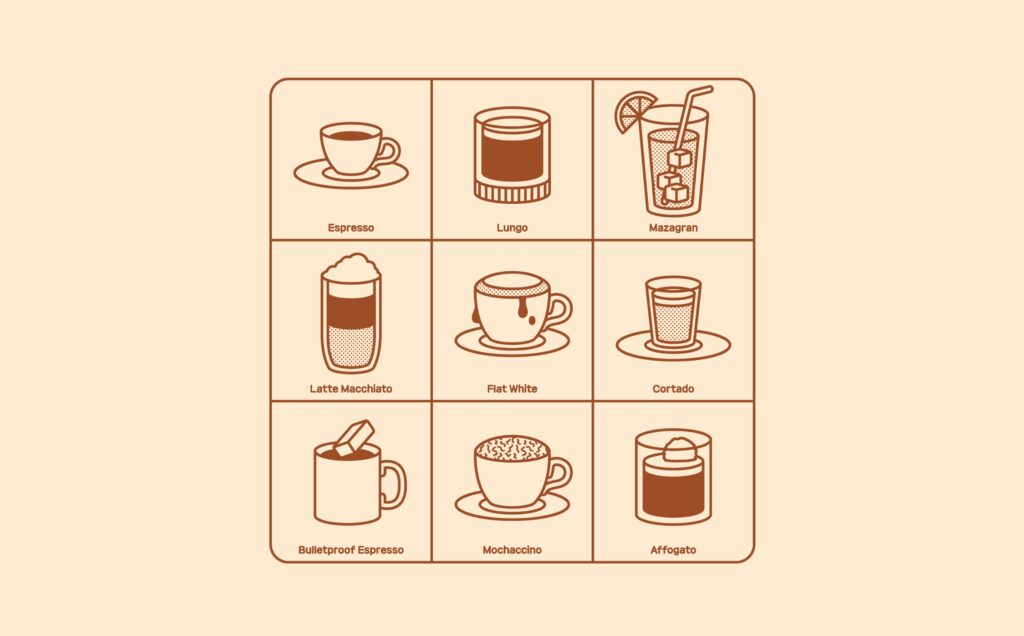
The most famous of all coffee preparations. The classic Italian espresso is made with 15 to 20 grams of ground coffee in a double filter carrier, under a pressure of 9 to 11 bars and with a brewing time of between 20 and 30 seconds. This yields 30 to 40 milliliters. The name has nothing to do with the speed of preparation. The word espresso comes from the Latin “ex” (from) and “presso” (pressure). It is a beverage that is “expressed”: water is forced through a bed of ground coffee under high pressure.
This “regular” coffee is still the most widely sold coffee preparation in the hospitality industry. Because it is brewed with an espresso machine, it has a layer of crema. Hence, French people call this variety café crème. The Italian name “lungo” means “long” and refers to its longer brewing time: more water passes through the same amount of ground coffee under the same pressure as an espresso. The capacity of a lungo is 75 to 95 milliliters.
A (double) espresso diluted with hot water. No boiling water, because that makes the taste bitter – take water of the same temperature with which the espresso is prepared, for example from the brewing group. The name came about when American servicemen in Italy during World War II kept adding water to what they thought was far too strong espresso. Some restaurants serve the americano as espresso in a large cup with hot water in a jug with it, so you can determine the ratio yourself.
Looks a lot like the americano, but reversed. With the long black, you first put 100 to 120 milliliters of hot water in a cup and then a double espresso. The advantage is that the crema remains somewhat intact, which looks nicer than an americano. A long black is usually a bit stronger in taste than an americano. There is debate about the origin: both Australia and New Zealand both claim the invention.
A “short” espresso of about 15 milliliters. You brew a ristretto by shortening the brewing time of an espresso to about 15 to 20 seconds. Because of the oils released at the beginning of extraction, the flavor is more intense and sweeter, and the mouthfeel syrupy. The name is derived from the Italian verb ristrettare, meaning “to withhold” or “to restrict. A restricted espresso, as it were.
Can it be stronger than ristretto? Absolutely. For those who really need a kick, there’s the red eye: a cup of filter coffee with an espresso in it. Need even more caffeine? Go for the superlative with the black eye (with two espressos) or the dead eye (with three espressos). Invented in America, these power drinks help truckers and night workers stay awake. And as if the names of these coffee preparations did not already capture the imagination, they also have nicknames. The red eye is known as “wake-up call” (for tired red eyes), the black eye is also called “double punch” (hence the blue eye – black eye in English) and the dead eye is nicknamed “triple eye” – after all, you squint from the amount of caffeine.
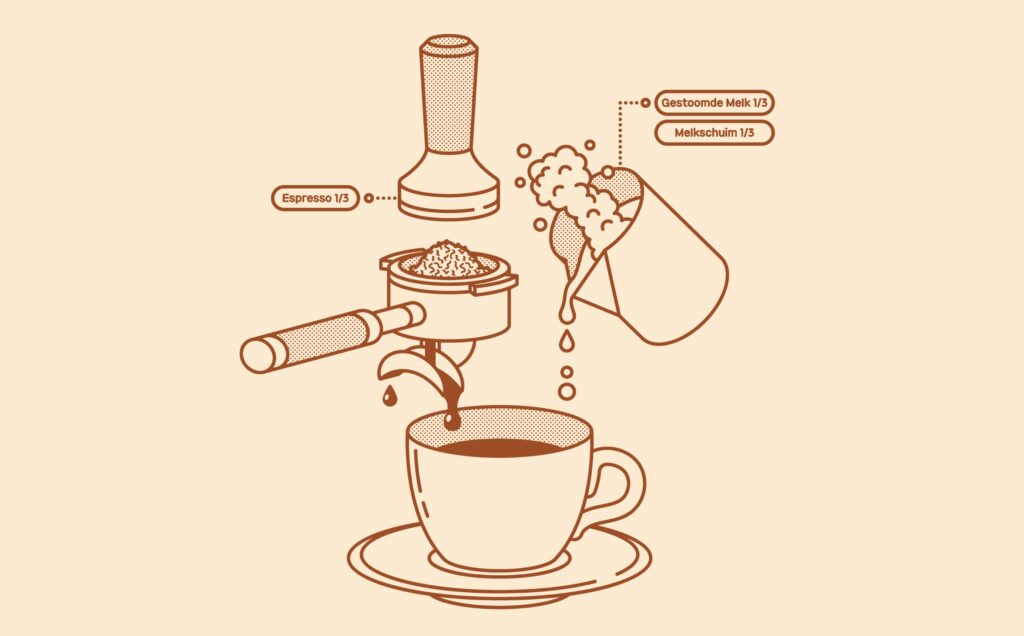
The mother of all milk coffees: 1/3 espresso, 1/3 steamed milk, 1/3 milk foam. Many people know that cappuccino is Italian for “little cap. Only it is often mistakenly assumed that this refers to the layer of foam, which is like a white cap on the coffee. In reality, the name refers to the Capuchins, a monastic order that was cloaked in chestnut-colored robes, exactly the color of the coffee drink under that layer of foam.
But the origins of cappuccino lie far before that of the technique of frothing milk. As early as the 18th century in Italy, people drank coffee with a splash of hot milk, giving the drink the color of a Capuchin’s habit, and thus calling it “a capuchin. The layer of frothed milk (and thus the white cap) on cappuccino was added only later, when the drink had long had its name. The technique of frothing milk with the espresso machine originated around 1930. That cappuccino also means “little cap” is because the word “cap” has the same origin: the Capuchin robes had a long cap, a cappuccio.
Similar in size to a cappuccino, but with less and thinner foam. The foam layer is flat and shiny, hence the name. Flat whites are usually prepared with a double ristretto, so the coffee flavor holds up despite the larger amount of milk. As with the long black, both Australia and New Zealand claim to be the birthplace of the flat white. What is certain is that the drink first appeared in the late 1980s. According to the Australian reading, guests at a coffee shop asked for a cappuccino with less foam; in the New Zealand version, a barista had too little milk in his jug, causing the frothing to fail.
Consists of 1/3 espresso or lungo with 2/3 hot milk, without foam (or a very small amount). In Italy, they were already drinking caffè lattes (then with filter coffee) in the 17th century. In the 1980s and 1990s, the drink became wildly popular in the United States, thanks to coffee chains like Peet’s and Starbucks. Sometimes caffè latte is confused with coffee preparations with names similar to it, such as latte (20) and latte macchiato (11).
Literally ‘coffee with milk’ in French. Better known in the Netherlands as ‘koffie verkeerd’: equal parts filter coffee and hot milk, without crema and without foam. In France, it is a classic breakfast drink, served in a large cup in which you can perfectly dip a croissant. The first mentions date back to the 17th century.
A popular drink in the hospitality industry consisting of 2/5 steamed milk, 2/5 milk foam and 1/5 espresso. You serve it in a tall glass, so the three layers are clearly visible. By carefully adding the espresso shot last, it settles between the milk and milk foam. The name means “spotted milk,” a reference to the brown spot that remains visible where the espresso breaks through the foam layer when poured. Latte macchiato originated in Italy in the 1980s as a counterpart to espresso macchiato (12). Popular in the hospitality industry, but because of its name, people often confuse it with caffè latte (9) or latte (20).
This is an espresso with a sprinkle of milk foam. Whereas a latte macchiato is “milk, flecked with coffee,” espresso macchiato actually means “coffee, flecked with milk. Caffè macchiato is also possible, in which case it is a lungo with a scoop of milk foam.
A mixture of equal parts espresso and steamed milk, with no foam, or at most a thin layer. The name means “cut” in Spanish: the espresso is cut with milk, so to speak. As the name suggests, this drink originated in Spain at the beginning of the 20th century.
The French answer to the Italian espresso macchiato and the Spanish cortado: an espresso with a splash of steamed milk and sometimes a little foam. The name means “hazelnut,” referring to the color of the drink, not the taste.
An espresso (or ristretto) with a splash of steamed milk and a thin layer of foam. This mini-flat white was invented early this century by Australian baristas who wanted to experiment with milk texture without having to make large coffee preparations all the time. They gave it an Italian name: piccolo meaning “small,” and is actually an abbreviation of the full, but less commonly used, name “piccolo latte.
Espresso with a dollop of whipped cream. The name means “whipped cream” in Italian. Therefore, this drink is also known as espresso con panna: espresso with cream.
A layer of espresso, a layer of melted dark chocolate (or chocolate sauce) and hot milk or whipped cream. The three layers are carefully poured into a glass so that they remain separately visible. Conceived in the 18th century by Caffè al Bicerin, a historic coffee house in Turin that opened in 1763 and still exists today. ‘Bicerin’ literally means ‘small glass’ in the local dialect, from which that coffeehouse in turn took its name.
1/3 espresso, 1/3 hot chocolate and 1/3 steamed milk, with milk foam on top. Named after the port city of Mocha in Yemen – a major transit port of coffee from the 16th to 18th centuries – although the café mocha itself was not coined until the 20th century.
A combination of 1/3 espresso, 1/3 steamed milk, a dash of chocolate syrup and 1/3 milk foam. Conceived in the 1990s by chains like Starbucks and Costa Coffee. A variation on this, with much more chocolate, is the chococcino: 1/3 espresso, 1/3 steamed chocolate milk and 1/3 chocolate milk foam.
A coffee variety without coffee: steamed milk and milk foam. Because of the different coffee preparations with “latte” in the name, confusion sometimes arises in the hospitality industry. Guests often order “a latte” and mean a latte macchiato. With a real latte, the milk is often supplemented with a syrup or powder for color and flavor. Think turmeric (golden latte), chai spices (chai latte) or matcha powder (matcha latte).
A cup of steamed milk and milk foam specially designed for the littlest guests. The babyccino originated in Australia early this century so that children could also have their “coffee moment” when parents were at the cappuccino or flat white.
Bulletproof espresso is a combination consisting of espresso with grass-fed butter or ghee and MCT oil (Medium Chain Triglycerides – concentrated coconut oil). The drink is blended in a blender to create a creamy energy booster. Dave Asprey, an American tech entrepreneur, came up with it in 2010, taking inspiration from Tibetan tea with yak butter. Bulletproof espresso is very high in calories: while a shot of espresso contains about 2 kcal, the number of kcal in a bulletproof espresso fluctuates between 200 and 400. Asprey claims the drink provides lightning-fast energy, increases your mental focus and fits perfectly within the keto diet (full of fats, no carbs). Bulletproof espresso is also popular with intermittent fasters and biohackers.
Cooled espresso with ice, lemon juice, sugar and/or rum. Considered one of the world’s first iced coffees. In 1840, during the siege of Fort Mazagran in Algeria, French soldiers had no milk for in their cafè au lait. And so they drank cooled coffee with water and lemon. They liked the taste and took the combination to cafes in Paris. There they started serving the drink with ice cubes, in a tall glass without an ear, which also got the name “mazagran. To make it slightly less bitter, they added sugar or syrup and sometimes rum. In modern versions, espresso is used and sparkling water or cola also goes in.
A scoop of vanilla ice cream topped with a hot (double) espresso. The name comes from the Italian verb affogare, which means “to drown”: the ice cream drowns in the espresso. The exact origin is not known, but the first affogatos were drunk in Italy in the early 20th century.
Freshly squeezed orange juice with a shot of espresso. ‘OJ’ is short for orange juice; the prefix dirty indicates that it contains a shot of espresso. Similarly, you can make other drinks “dirty” by adding espresso, such as a dirty chai latte.










Coffee and tea experts share seasonal recipes and practical ideas for restaurant menus. The workshops take place at a pick-your-own garden in Stoutenburg.

These classic madeleines from The Art of Baking by Hidde de Brabander combine a soft texture with a rich buttery taste.

In this article, we debunk 10 persistent fables and myths about coffee. From caffeine to Kaldi and from oil to dehydration. What is really true, and what is mostly a persistent misconception?


