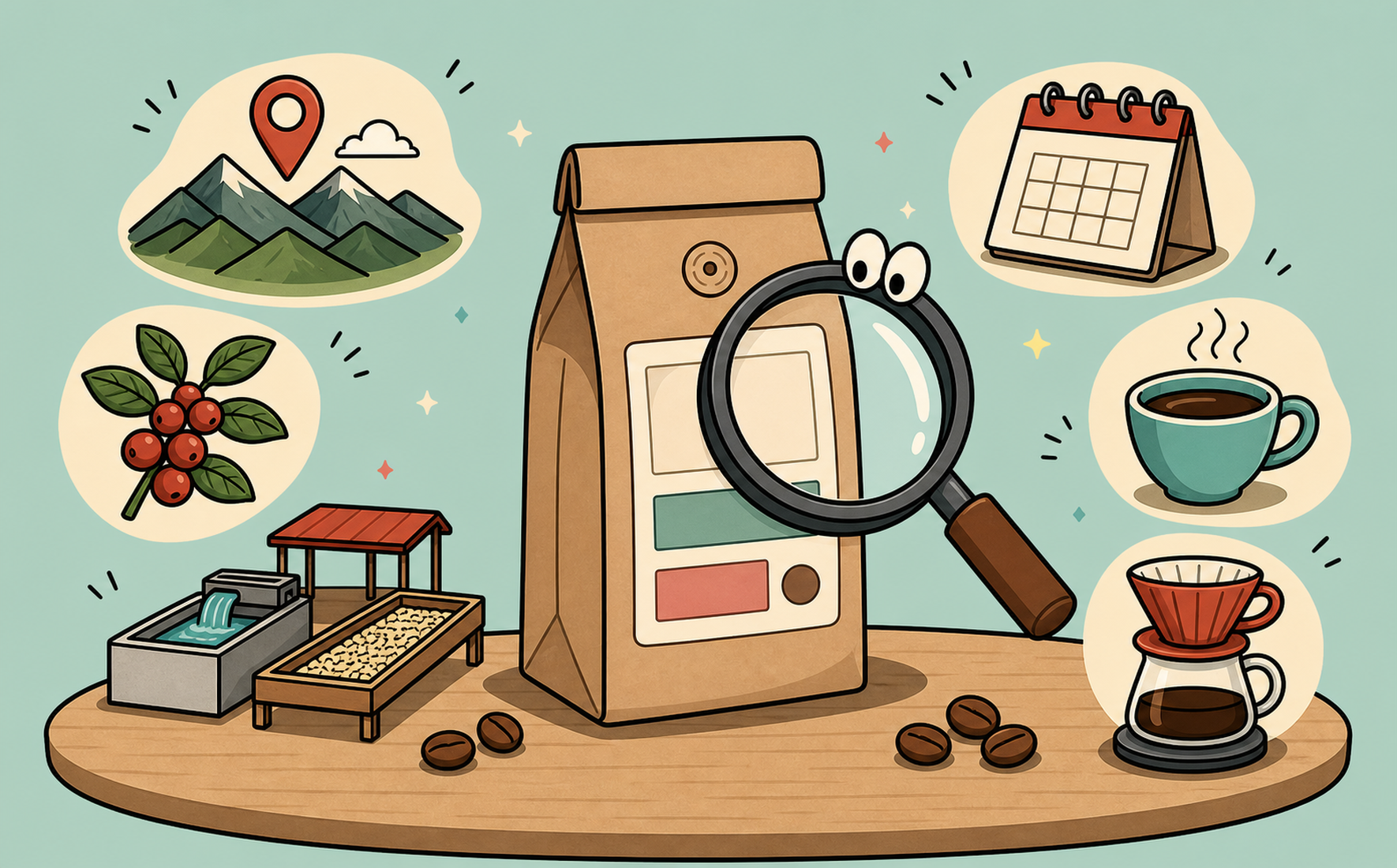
When you pick up a bag of specialty coffee, you’ll often see much more information than on a typical package of supermarket filter coffee. Country of origin, region, variety, processing method, roast date, tasting notes, brewing recommendations: sometimes a coffee package almost looks like a passport. But what use is all that to you as a coffee drinker?
In this guide, Richard Schukkink of ITC Academy explains, step by step, what information you might find on a coffee bag. Not to make coffee more complicated, but rather to help you better understand which coffee suits your taste and brewing method.
Many people choose coffee based on the front of the package. A name, color, image, or recognizable logo often determines which bag is picked off the shelf. That makes sense: the front is designed to stand out.
Still, most of the information is usually found on the back, the side, or on a card that comes with the coffee. There you’ll find details about the origin, processing, roasting, flavor profile, and sometimes even the producer. It’s precisely that information that helps you better assess what you’re buying.
Not all information serves the same purpose
Coffee packaging contains a mix of different types of information. Some details are required by law, such as the weight, the best-by date, and information about the manufacturer or seller. Other information is intended to help you make a choice, such as the recommended brewing method, the roast date, or a description of the flavor.
In addition, there are elements that are primarily associated with a distiller’s brand identity or marketing. These include product names, colors, illustrations, and alcohol content ratings. While these can be useful within a single brand, they are not always objectively comparable to other brands.
So an intensity level of 8 for one roaster doesn’t necessarily mean the same thing as an intensity level of 8 for another roaster. And gold packaging doesn’t automatically mean the coffee is better than a bag with a plain white label.
Why is there more and more on the bag?
Over the past twenty years, the amount of information on coffee packaging has increased significantly. Whereas in the past, packages often featured only terms such as “filter coffee,” “espresso,” or “quick-filter grind,” many roasters now also list the country, region, altitude at which the coffee was grown, variety, processing method, and sometimes even the name of the farm, producer, or washing station.
Transparency plays a major role, especially in the specialty coffee sector. Roasters want to show where the coffee comes from, how it was processed, and who worked on it. For coffee drinkers, this makes the choice more interesting, but sometimes also more complicated. After all, more information doesn’t automatically mean you’ll immediately understand what’s ending up in your cup.
From Origin to Flavor
Some terms on a coffee bag provide information about where the coffee was grown. These include country, region, subregion, farm, or washing station. Other terms refer to the plant itself, such as Arabica, Robusta, Bourbon, Typica, Gesha, or SL28.
Processing also plays a role. Terms like “washed,” “natural,” “honey,” and “anaerobic” indicate what happened to the coffee cherry after harvest. Next comes the roaster, with decisions regarding roast level, roast date, and brewing recommendations.
All of these details are building blocks. Taken separately, they tell only part of the story. Together, they paint a much clearer picture of what you can expect: fresh and floral, round and chocolatey, distinctly fruity, spicy, robust, or, conversely, refined.
Flavor notes are not ingredients
Many specialty coffees are described with flavor notes such as citrus, caramel, jasmine, red fruit, or dark chocolate. This does not mean that these ingredients have been added to the coffee. Rather, they are aromas that the taster recognizes in the coffee.
Tasting notes are mainly useful for comparing different coffees. Don’t think of them as a guarantee, but rather as a guide. If you frequently taste coffees whose packaging mentions blackcurrant, citrus, or floral notes, you’ll naturally discover whether those flavor profiles suit your taste.
Learning to Read a Coffee Bag
The purpose of this article is not to claim that one type of coffee is better than another. A dark espresso blend can have just as many fans as a light-roasted filter coffee. A carefully crafted blend can be just as interesting as a single-origin coffee.
The bottom line: you’ll learn how to better interpret the information on a coffee package. What does something really say about the taste? What is mainly a marketing ploy? And which details will help you make a more informed choice next time?
If you learn to read a coffee bag label, you’ll make fewer impulse purchases. You’ll discover more quickly which origin, processing method, brand, and flavor description match your preferences. And yes, that label suddenly becomes a lot more interesting.
Read more
Over the coming period, the chapters will be linked to the in-depth articles one by one.
Want to learn more? Join koffieTcacao and get access to exclusive articles, interviews, and tips on specialty coffee, tea, and cacao. That way, you’ll always stay up to date on trends, gear, and events.
Yerevan is best known for its rich history, but is developing into a surprising destination for specialty coffee. On this city trip to the Armenian capital, you’ll discover hidden roasteries, modern coffee bars, and a traditional tea house.