


Laatst bijgewerkt op: 08/07/2026
When people talk about matcha, the conversation often turns to grinding. Yet a large part of the final quality is already determined before the grinder even comes into play. This is because matcha isn’t made directly from fresh leaves, but from tencha, and the way that tencha is produced is crucial.
Tencha processing differs fundamentally from that of other Japanese green teas. The goal is not to shape the leaf or control extraction, but to keep the leaf tissue as intact and pure as possible for later grinding. Every step in this process has a direct impact on color, aroma, mouthfeel, and frothing properties.
The information in this article is based on the practical experience and teaching materials of Richard Schukkink, founder of the International Tea and Coffee Academy.
This article is part of the Matcha dossier. The complete overview of all articles, from cultivation and processing to brewing and applications, can be found on the overview page: Matcha explained: from tea leaf to bowl.
With sencha, processing revolves around rolling. By kneading and shaping the leaf, the cell structure is opened up and extraction is controlled. With matcha, that doesn’t work. Since you’re drinking the whole leaf, you specifically want to avoid a rolled structure, broken veins, and uncontrolled cell damage.
Tencha processing therefore has one main goal: to preserve the tender leaf tissue so that it can be ground evenly later on. This requires different approaches to steaming, drying, and sorting.
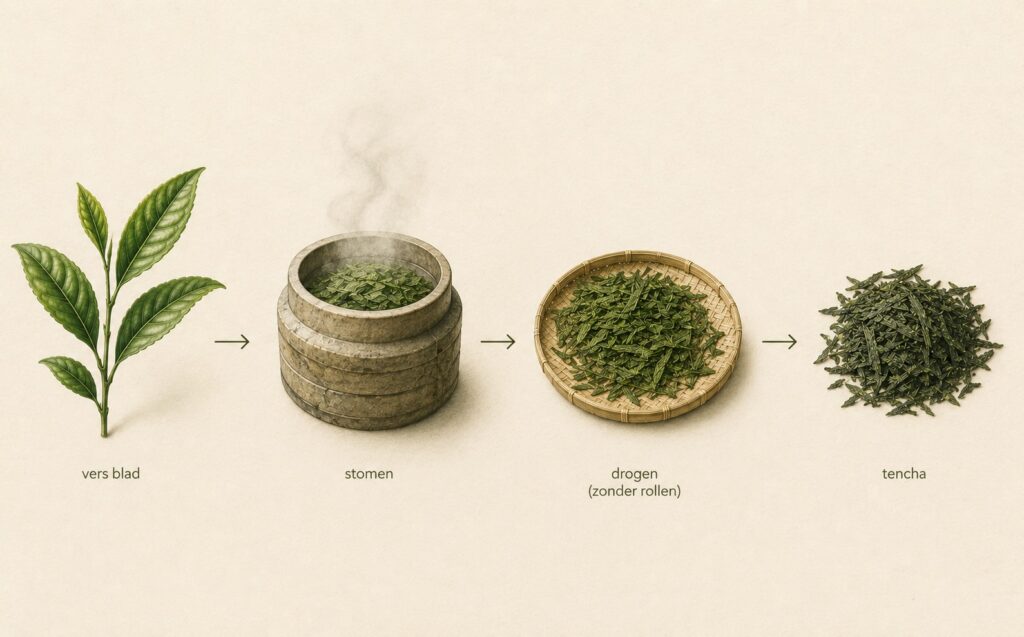
As with other Japanese green teas, steaming is the first step after harvesting. The goal is to stop enzymatic oxidation and preserve the color and aroma.
With tencha, this step is particularly critical. Matcha is extremely sensitive to color. Even slight oxidation can later, after grinding, result in a dull, olive-like hue.
However, steaming at too high a temperature can also cause problems:
Steaming at too low a temperature can actually lead to:
The trick is to use enough steam to completely stop oxidation without damaging the leaf’s sensory qualities.
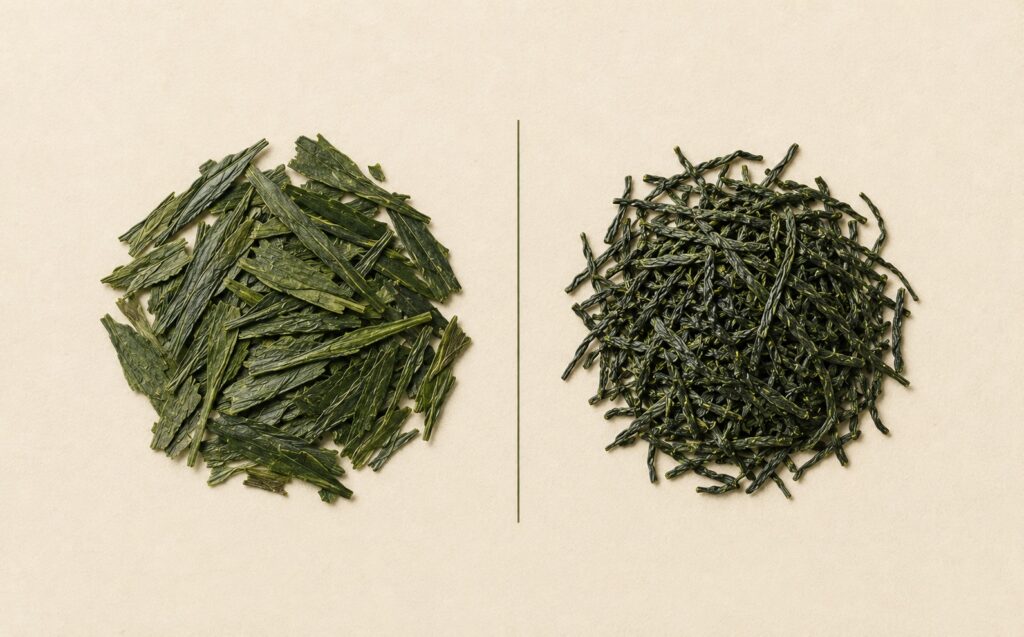
After steaming, tencha is dried but not rolled. This is one of the main differences between tencha and sencha.
Drying must:
Drying too slowly increases the risk of musty or closed notes. Drying at too high a temperature can result in a “baked” character and a loss of fresh, green aromas.
Because tencha must later undergo de-stemming and grinding, this balance is essential. Errors made at this stage cannot be corrected.
After drying, tencha is sorted and the stems and leaf veins are removed. This process is called de-stemming and is one of the most underrated factors affecting matcha quality.
Stems and veins contain:
If they are not carefully removed, this will later result in:
High-quality matcha is made almost entirely from leaf lamina. This makes the powder smoother, creamier, and better suited for high concentrations.
De-molding is labor-intensive and costly, but essential for top quality.
Not every leaf that is suitable for tencha is automatically suitable for the same use. At this stage, different fractions are often separated.
For example, pages can be selected based on:
Leaves with a slightly more textured surface work exceptionally well for latte or culinary matcha. The softest and most uniform parts are often reserved for usucha and koicha.
This explains why a single harvest can yield multiple matcha profiles.
Tencha must be sufficiently stable before grinding. Final drying ensures the proper moisture balance, so that the leaves:
Excessive residual moisture increases the risk of quality loss during storage. Leaves that are too dry can become brittle and cause undesirable effects during grinding, such as excessive heat generation or premature particle size reduction.
The same applies here: stability is more important than extremes.
Tencha serves as a crucial link in the matcha production chain. It is at this stage that the true potential of the leaf becomes apparent. Its tenderness, color stability, and suitability for fine grinding become evident here, even before the powder is produced.
Problems that become apparent later in the matcha, such as harsh bitterness, a gritty mouthfeel, or unstable foam, are often already present in the tencha. Grinding can either intensify or soften these characteristics, but it cannot eliminate them. Anything that is off at this stage will remain noticeable in the bowl.
Since tencha is almost never sold as a finished product, this step remains hidden from many consumers. Naturally, the focus is on the powder and the preparation, while the critical decisions were made earlier in the process. Therefore, anyone who wants to understand or evaluate matcha cannot rely solely on its color or foam. The quality of tencha determines what is even possible in the final product.
This article is part of the Matcha dossier. The complete overview of all articles, from cultivation and processing to brewing and applications, can be found on the overview page: Matcha explained: from tea leaf to bowl.




















According to Spencer Hyman, founder of the artisanal chocolate platform Cocoa Runners, we need to learn to eat chocolate differently.

Yerevan is best known for its rich history, but is developing into a surprising destination for specialty coffee. On this city trip to the Armenian capital, you’ll discover hidden roasteries, modern coffee bars, and a traditional tea house.

From higher Fairtrade prices and coffee beans for home use to an exhibition on coffee and colonial history: here's what's happening in September.


