


Gepubliceerd op: 27/06/2023
Central Asia has only recently become a tourist destination. This makes the region all the more interesting to tea traveler and author Deirdre Deprettere. Curious about local tea cultures, she followed the ancient Silk Road and traveled to Uzbekistan, among other places. Everywhere she went, she was welcomed with a cup of tea.
In Uzbekistan, it’s impossible to imagine life without tea. Tea is liquid hospitality. Just as in China or Japan, there is a whole set of rules, customs, and traditions surrounding tea. You drink tea from a piala, a small bowl. There is always an extra piala, which serves an important function: kaitar, which means “to return.”
Before serving the tea, the extra piala is used to pour the tea back into the teapot—three times. The first time is called loy; the second time, moy; the third choy: loy, moy, choy. Only after the third time of returning the drink does it become choy: tea ready to drink.
After the ritual kaitar, the first serving is for the host. This custom dates back to a time when the host had to prove that the tea had not been poisoned. The second serving is for the most important or oldest guest.
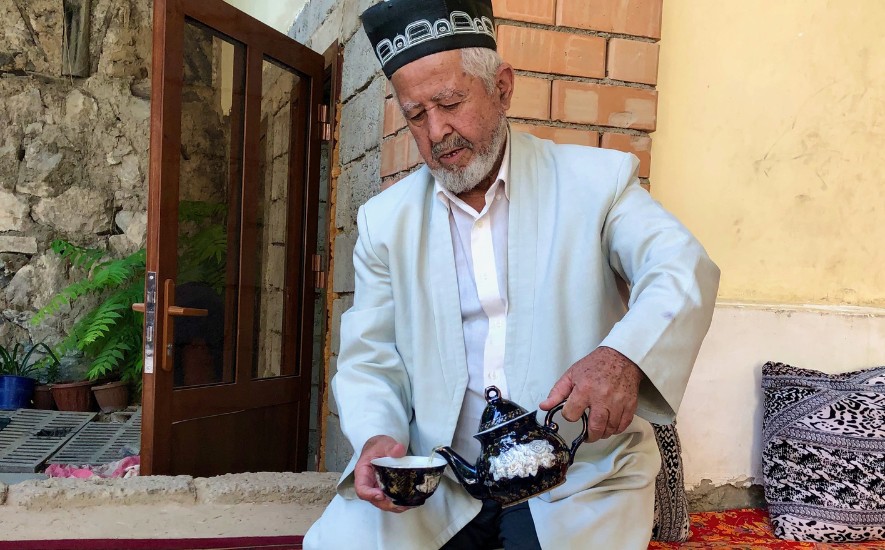
A distinctive aspect of Uzbek etiquette and hospitality is that only a certain amount of tea is poured—about half a piala, or even less. The more highly a guest is regarded, the less tea is poured into the piala. The more often the host can pour, the better.
A bowl filled to the brim goes against all norms of hospitality. If you pour a cup full, it means your life is full. It’s over. Time to die. When Uzbeks want you to stay, they fill the bowl halfway and keep refilling it.
Chorpaya
In Uzbekistan, people often drink tea from a chorpoya: essentially a wooden platform covered with rugs and cushions, with a low table on top. You’ll find this multifunctional piece of furniture everywhere in Uzbekistan and Tajikistan: in teahouses, the gardens of private homes, hotels, palaces, parks, in the mountains, under the trees in a village square, or simply along the roadside.
Until recently, Uzbekistan was one of the most isolated places on Earth. Five years ago, Uzbekistan opened its borders to let adventurous travelers experience the history and heritage of the legendary Silk Road. Reportedly, Uzbekistan also aims to become a major player in the tea market in the coming years.
The plan is to establish tea plantations covering a total area of 283 hectares, to develop technology for the successful cultivation of tea, and to provide farmers with seeds and seedlings. By 2025, Uzbekistan aims to produce 189 metric tons of tea annually.
A logical step in a country where people drink enormous amounts of tea—nearly 30,000 metric tons annually. The most popular types are green tea, kuk-choy, while in the capital, Tashkent, kora-choy, black tea, is the preferred choice. Tea is drunk almost everywhere without sugar or milk. However, herbs and spices are sometimes added to the tea.
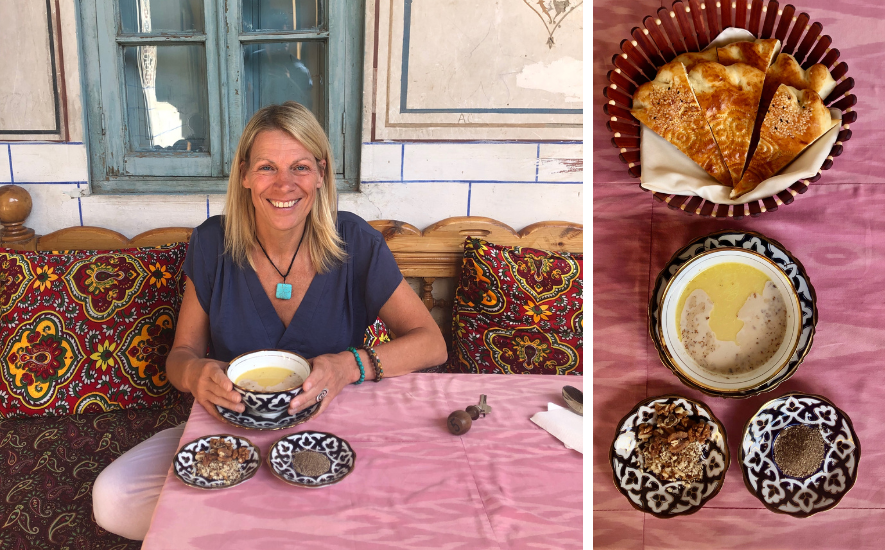
There’s even a special breakfast drink: shir choy. Nomadic tribes throughout Central Asia drink this nutritious milk tea. Although the Uzbeks were not traditionally nomads, some Central Asian nomadic customs can be found in their food and drink, such as shir choy and the use of sour, fermented milk.
The ingredients for the tea—which actually resembles soup more than anything else—vary depending on what’s available: black tea, milk, salt, and butter, along with other possible ingredients such as black pepper and walnuts. Shir choy is the nomadic equivalent of fast food: hot, flavorful, and high in calories. For those accustomed to drinking plain tea, shir choy has an unusual flavor.
Caravan from East to West
The Silk Road owes its name to a network of major trade and caravan routes that connected the East and the West for centuries. From silk, porcelain, spices, and carpets to paper, horses, grapevines, medicinal plants, and, of course, tea: everything was traded along the Silk Road. Ideas and knowledge were also exchanged freely.Central Asia lay at the heart of the Silk Road: a region bounded by the Caspian Sea to the west, China and Mongolia to the east, Afghanistan and Iran to the south, and Russia to the north. Today, it comprises the five republics of Kazakhstan, Kyrgyzstan, Tajikistan, Turkmenistan, and Uzbekistan, also known as “the Stans.”
Are you planning to travel to Uzbekistan on your own soon? If so, be sure to visit Silk Road Spices & Tea House in Bukhara. Housed in a beautiful old house with colorful tapestries on the walls, this teahouse is run by the Ubaydov family.
With his Silk Road Spices, Mirfayz followed in the footsteps of his ancestors, who have been in the spice trade for over six hundred years. His son Mirshahob opened this wonderful teahouse, where the aromas of cardamom, cloves, nutmeg, anise, and mint greet you.
Want to know everything about tea? In her book *Tea Routes*, Deirdre takes you on a journey to the most beautiful tea-growing regions in the world.



















According to Spencer Hyman, founder of the artisanal chocolate platform Cocoa Runners, we need to learn to eat chocolate differently.

Yerevan is best known for its rich history, but is developing into a surprising destination for specialty coffee. On this city trip to the Armenian capital, you’ll discover hidden roasteries, modern coffee bars, and a traditional tea house.

From higher Fairtrade prices and coffee beans for home use to an exhibition on coffee and colonial history: here's what's happening in September.


