

Gepubliceerd op: 17/01/2024
Many coffee farmers in Rwanda want to increase their coffee yields, but their old coffee trees are standing in the way of this growth. Coffee farmers Uzziel Mushatsi and Christine Mukeshimana also experienced this. They lacked the resources and funding needed to increase their yields. Here’s how Rwacof (Sucafina’s sister company in Rwanda) and the London School of Economics helped them achieve this.
Currently, yields per tree in Rwanda are quite low compared to the global average. Low yields are primarily due to the age of the trees; the average coffee tree in Rwanda is 20 years old. Although pruning can increase production, the cost of labor and the loss of income pose an obstacle for Rwandan coffee farmers. “Pruning is not a new concept, but it has not yet been widely adopted because it is labor-intensive. For small farms, this means that farmers lose a large portion of their income for three years while the tree regrows,” explains Maryann Wanja, an R&D staff member and agricultural scientist at Rwacof.
In collaboration with the London School of Economics (LSE) and Rwacof , farmers like Uzziel and Christine can receive funding to pay workers to prune their trees and to offset the loss of income during fruit-bearing periods. When developing this project, the LSE and Rwacof felt it was important for the farmers participating in the project to have a say in how it was implemented. That is why a focus group was established in which the Rwandan farmers could determine what was needed to successfully prune their trees. Arcade Nkundineza, Research Project Manager at LSE, explains that the farmers’ input led Rwacof to provide funding for labor during the pruning process.
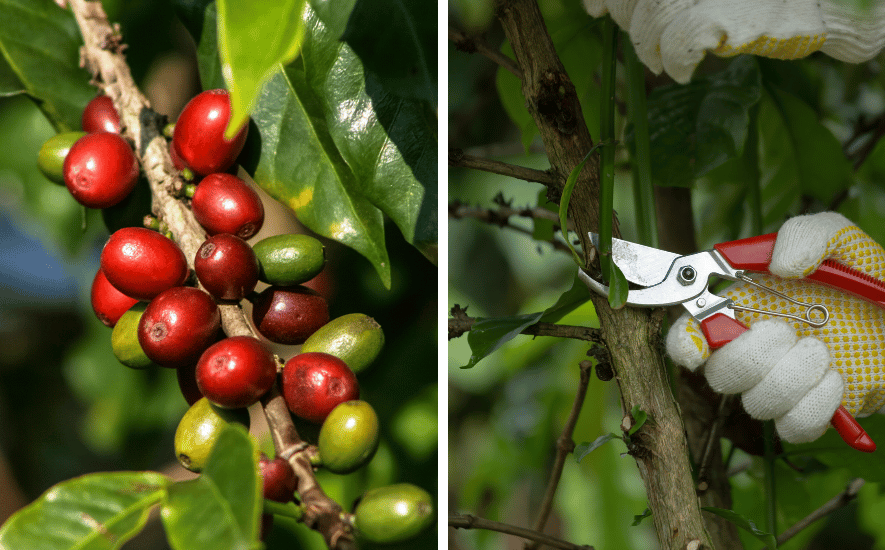
For coffee farmer Christine Mukeshimana, the benefits will be reflected in higher yields once the pruned trees begin bearing fruit again in about three years. “I have revitalized 332 coffee trees,” says Christine. “Our coffee trees were so old that they were no longer producing well. When we start harvesting again, our coffee production will increase significantly.” According to Tom Swinkels, head of strategic projects at Rwacof, farmers who prune their trees can expect a potential 200% increase in income by the fourth year after pruning.
Coffee roasters who purchase Rwandan coffee can also contribute to the success of this program. A significant portion of the money paid to farmers for their labor and expenses is provided by the Sucafina’s Farmgate Initiative program. The Farmgate Initiative offers roasters the opportunity to invest directly in the supply chains that matter to them. Sales of selected Rwandan coffees contribute to this pruning project. Since 2023, Farmgate Initiative has contributed more than 35 thousand euros to this project. Between July and August 2023, more than 1,000 farmers—38% of whom were women—signed up to revitalize more than 190,000 coffee trees through the program. The latest update on pruning efforts? As of December 2023, approximately 118,000 trees have been successfully pruned.
Rwacof and LSE hope to collaborate with even more farmers in the coming years to facilitate the rejuvenation of coffee trees in Rwanda.
Want to learn more about Sucafina’s sustainability initiatives? Visit the website.



















According to Spencer Hyman, founder of the artisanal chocolate platform Cocoa Runners, we need to learn to eat chocolate differently.

Yerevan is best known for its rich history, but is developing into a surprising destination for specialty coffee. On this city trip to the Armenian capital, you’ll discover hidden roasteries, modern coffee bars, and a traditional tea house.

From higher Fairtrade prices and coffee beans for home use to an exhibition on coffee and colonial history: here's what's happening in September.


