


Gepubliceerd op: 06/01/2021
Just outside Porto, former journalist Nina Gruntkowski has been running her own tea garden, Cha Camélia, for several years now, producing artisanal, organic green teas.
For a German television network, Nina Gruntkowski interviewed an international tea specialist, who gave her a tea plant as a gift. That tea plant was the first of two hundred to be planted in the experimental tea garden at her home when she moved to Portugal for love.
The former journalist met her husband during a work trip to the family vineyard in the Douro. She now runs her own tea garden, Cha Camélia, just outside Porto, which we’ll visit during the koffieTcacao 37 city trip.
Those were two life-changing reports, weren’t they…?
Smiling: “That’s right! We eventually started importing Japanese loose-leaf teas to offer an alternative to supermarket tea. When my in-laws moved to the city and this estate became available, I decided to tea myself. Now, one hectare is planted with 12,000 tea plants. The rest is reserved for fruit trees, which also provide shade.”
Chá Camélia is the first tea plantation on the Portuguese mainland and one of only a few in all of Europe. Do you actually have the right conditions for growing tea?
“Yes, the rich soil and the climate make this place very suitable for growing tea. Compared to the rest of Portugal, it rains often in Porto, which is good for the tea plant. But above all, it takes a lot of time to invest in a tea plantation. It takes about ten years before you can actually start harvesting. That discourages many people—especially those who want to make money—from growing tea here.”
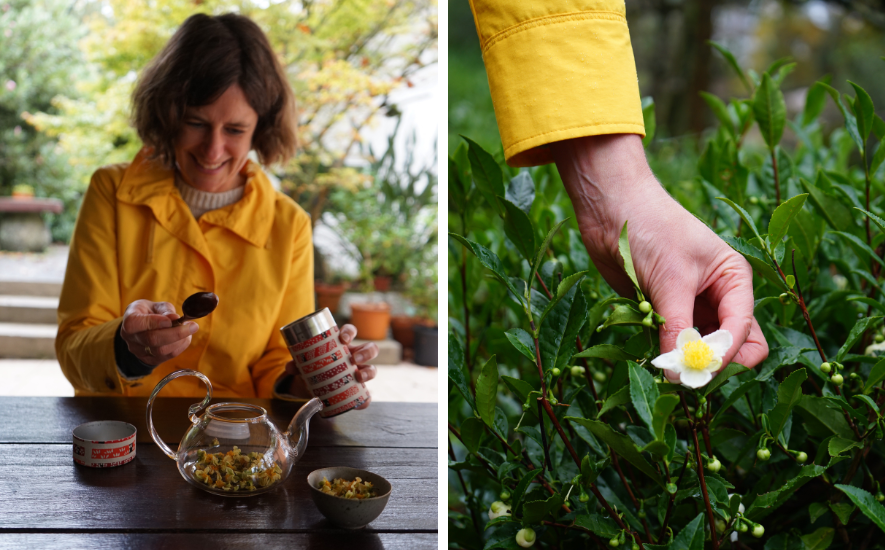
As the first raindrops begin to fall during this city trip, Nina shows us around the plantation. Our first stop is the nursery with the two-year-old plants.
Cha Camélia uses the beautiful white tea flowers that bloom there to make a caffeine-free infusion. The older, 6-year-old “brothers and sisters” stand in equally neat rows spread across five terraces. Bees are buzzing all around us.
Is that a direct result of biodynamic farming?
“Absolutely. We weed everything by hand, spray all the plants monthly with a natural spray, and make our own compost from cow manure. Of course, we also pick the tea by hand. This year’s first flush in April and second harvest in June yielded a total of 50 kilograms of tea. Our goal is to double that amount within four years.”
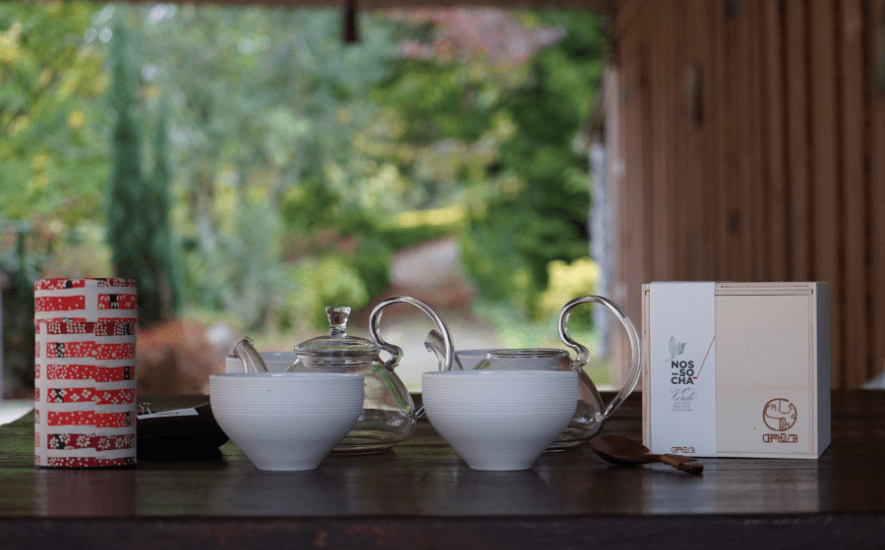
Outside at the picnic table, Nina prepares the first harvest of green tea for us. The Nosso Chá is hand-picked and processed according to Japanese tradition: steamed, pan-dried, dried on a mesh screen, rolled, and dried again. Use five grams per 200 millimeters, steep for three minutes steeping time and water at 80°C, we taste a fresh spring tea with vegetal undertones.
Who buys your tea?
“We distribute mostly within Portugal and Spain, but we supply restaurants throughout Europe. Some serve our tea with dessert to cleanse the palate. Our largest customer is located in Macau, China. They love our tea, which is aged in port barrels.”
You can easily order Chá Camélia tea online. Would you like to visit the plantation as well? Please contact Nina!
Wondering where to go in Porto for coffee as well as tea? Check out the 8 specialty coffee shops in Porto, or read the full city guide in *koffieTcacao* 37.




















According to Spencer Hyman, founder of the artisanal chocolate platform Cocoa Runners, we need to learn to eat chocolate differently.

Yerevan is best known for its rich history, but is developing into a surprising destination for specialty coffee. On this city trip to the Armenian capital, you’ll discover hidden roasteries, modern coffee bars, and a traditional tea house.

From higher Fairtrade prices and coffee beans for home use to an exhibition on coffee and colonial history: here's what's happening in September.


