

Gepubliceerd op: 26/04/2022
For a long time, Liberian cocoa had a poor international reputation due to its inconsistent quality, and the West African country lagged behind its neighbors, Ivory Coast and Ghana. With guidance from the Netherlands, Liberia has taken steps over the past three years to put its local cocoa on the map.
In 2018, a cocoa expert from the CBI traveled to Liberia. There, he visited about ten companies that could benefit from coaching and practical assistance with cocoa exports. Jack Steijn, a chocolate connoisseur and co-owner of Chocoa, was also there. In koffieTcacao 33 he provided a detailed account of the trip.
More than three years later, we speak with Anne-Marie Roorda, program manager at the CBI, about Liberia’s achievements, the challenges the country faces, and the future of the Liberian cocoa industry.
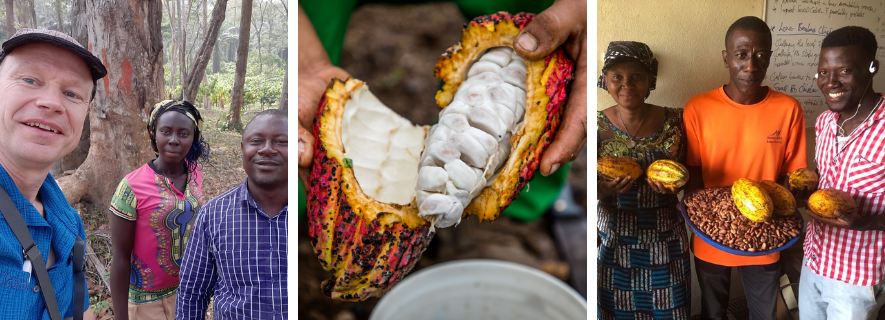
In 2018, the CBI set itself the ambitious goal in this project of guiding seventeen companies in Liberia and Sierra Leone toward improvements in cocoa cultivation itself and all business aspects, such as marketing, exports, and securing financing.
It became clear fairly quickly that this goal might have been a little too ambitious, says Anne-Marie. “It turned out that coaching ten companies at the same time wasn’t effective. That’s why, in line with the Sustainable Market Transformation strategy, we decided to shift our focus to three frontrunners. We’re essentially preparing them to serve as role models for other small and medium-sized cocoa companies in Liberia.”
The three companies with which the CBI has been working closely for the past three years are Atlantic Cocoa Processing & Exporting Company, Liberation Cocoa and Liberia Cocoa Cooperation.
For a country with very fertile soil and an ideal climate for cocoa cultivation, developing the sector proved to be more difficult than expected. Historically, Liberia has not done much to improve the value or volume of its cocoa exports. As a result, cocoa has always had a low commercial value.
Due to a large amount of illegal cross-border trade , the traceability and reliability of the product are compromised. Liberian cocoa beans are smuggled across the border and sold from other countries at the highest possible price. The cocoa is no longer traceable, and no one knows on which plantation it was grown.
This encourages theft. Furthermore, it makes it impossible to provide guarantees regarding certification for organic farming or fair labor practices. Cocoa varieties from Ivory Coast and Ghana are also being introduced into Liberia. While this is technically legal, it has adverse consequences due to the diseases these varieties carry.
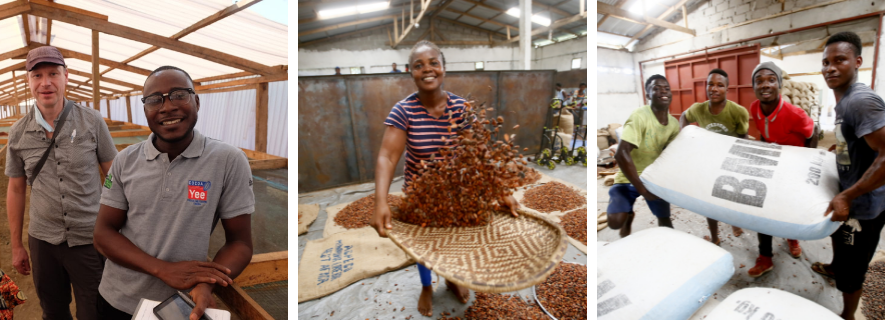
This illegal trade is also devastating for the incomes of Liberian cocoa farmers, who see none of that money. The government is struggling to control these exports. The weak institutional environment in Liberia proved to be one of the most difficult challenges for the CBI. Politicians in this West African country are highly susceptible to bribery because wages are so low.
Liberia is one of the least developed countries in the world, and education is poor or nonexistent. In the travel report in koffieTcacao 43, Jack also discusses the problems caused by the lack of infrastructure, which makes cocoa exports vulnerable to weather conditions.
During the rainy season, the roads are so muddy that it’s impossible to travel at all, let alone transport cocoa. On top of that, the pandemic didn’t help matters over the past two years. As a result, the CBI was unable to travel to Liberia, and all communication had to take place digitally. In a country like Liberia with poor internet connections, that was, to put it mildly, a challenge.
Anne-Marie says that important changes are now gradually taking shape. “We’re trying, slowly but surely, to build a track record with the companies we coach, so that interested parties can see what kind of wonderful and delicious cacao comes from Liberia.”
This is starting to pay off. Independent bean-to-bar chocolate makers and importers are discovering the three Liberian front-runners on their own. National Organization Committees (NOCs) have also been established, which are required to participate in Cocoa of Excellence.
And just before Chocoa 2021, the Liberia Cocoa Cooperation launched its first chocolate bar, and in December of that year, the Atlantic Cacao Processing & Exporting Company obtained its organic certification.
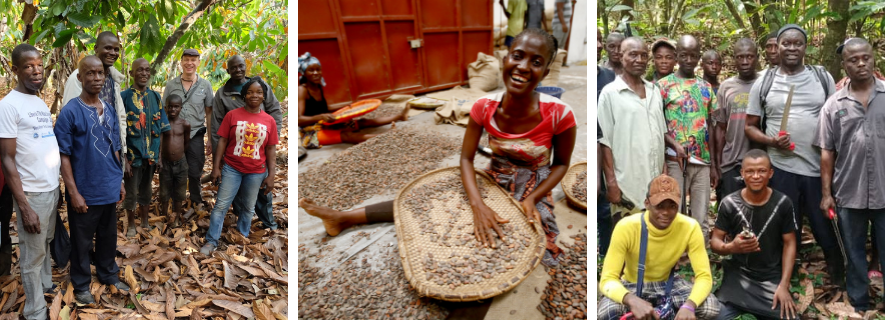
Over the coming year, the CBI will continue to be fully committed to providing intensive support to the three frontrunners. Together with the Liberia Cocoa Corporation, they are setting up a Quality Lab where cocoa producers can conduct quality assessments of their cocoa.
Currently, Liberian cocoa farmers have to travel to Ghana for this. LCC can then offer this service to other cocoa companies as well. Based on these quality assessments, farmers can send more targeted samples to importers in Europe. The CBI is also helping the government establish a protocol for the export of organically certified products.
At the moment, this does not yet exist, which means that no clear guidelines are being followed at the port, and organic cocoa is often not recognized as organic when it arrives at its destination. As a result, the farmer loses all of his profit.
Trade, Not Aid
The CBI supports companies in developing countries worldwide in exporting to the European market. This project focuses on cocoa companies and cooperatives in Liberia and Sierra Leone and is carried out in collaboration with the International Trade Centre, other partners such as WHH, a United Nations agency, and the World Trade Organization.
Read more about the Liberia project.










This bright green tea powder comes from a remote mountain community in China and is perfect for tea and (iced) matcha lattes.

Coffee and tea experts share seasonal recipes and practical ideas for restaurant menus. The workshops take place at a pick-your-own garden in Stoutenburg.

These classic madeleines from The Art of Baking by Hidde de Brabander combine a soft texture with a rich buttery taste.


